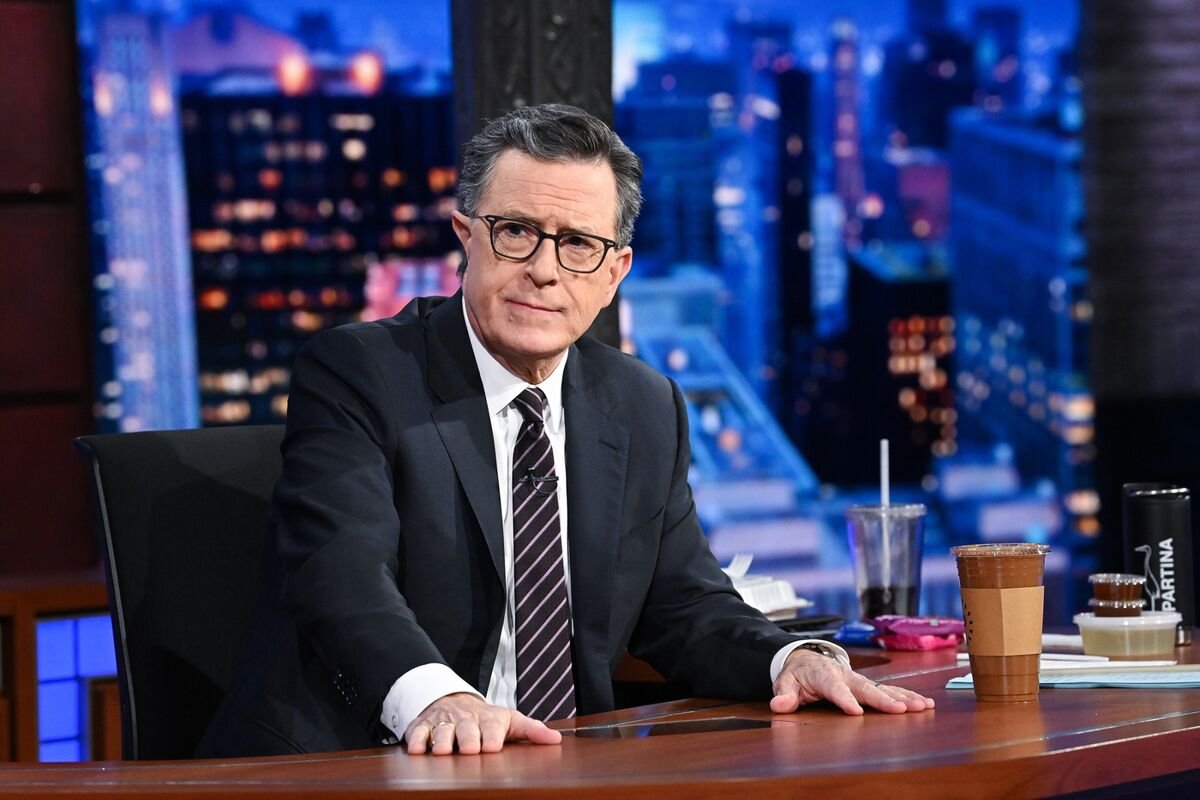
There is commitment to a bit, and then there is what Stephen Colbert did exactly 24 hours after turning off the lights on CBS’s The Late Show.
Following an emotional, star-studded final network broadcast precipitated by Paramount’s controversial “financial decision” to cancel the 33-year-old late-night staple, Colbert didn’t head to a beach or slip into a quiet retirement. Instead, he popped back up on a public access cable station in southeast Michigan, hijacking an hour of local television on Monroe Community Media’s Only in Monroe.
It was a staggering, deeply funny act of comedic rebellion. Appearing alongside a deadpan Jack White and a hammer-wielding Jeff Daniels, Colbert used the ultra-low-budget venue to deliver a masterclass in anti-television, proving that while network suits can take away a budget, they can’t take away the microphone.
The Ultimate Call-Back Blueprint
For deep-cut late-night historians, the choice of venue was no accident. In July 2015, during the anxious, transitional summer between ending The Colbert Report and inheriting David Letterman’s desk, Colbert pulled a viral stunt by quietly traveling to Monroe to host a full episode of the exact same public access show.
That 2015 episode—infamous for Colbert interviewing a bemused Eminem as if he were just a local “Marshall Mathers trying to make a name for himself in the competitive world of music”—became the structural DNA of The Late Show. It birthed his popular, recurring “Community Calendar” segment.
When Colbert closed his final CBS episode by throwing a giant power switch, viewers with sharp eyes noticed a smaller toggle on the wall labeled “ONLY IN MONROE.” The Friday night broadcast was the payoff to that easter egg—a perfect bookend showing that his network run began and ended in a small room on the shores of Lake Erie.
High-Profile Chaos on a Zero-Dollar Budget
The sheer absurdity of the production lay in the contrast between its minimal local footprint and the generational talent squeezed into the frame. Delivering deadpan monologue jokes about local hot dog rivalries between “Monroe’s Original” and “Vince’s” to a tiny crew of camera operators actively holding back laughter, Colbert treated the public access studio like the ultimate playground.
The hour unfolded as a surreal mix of local interest and subverted late-night tropes:
| The Segment | The Public Access Execution |
| The House Band | Rock icon Jack White served as “volunteer music director,” joining Colbert for a Lady and the Tramp-style taste test of local chili dogs. |
| The Star Interview | Michigan native Jeff Daniels sat for the “Colbert Questionert” while assembling a sandwich, explaining that he chooses to live in the state because he “never bought into fame.” |
| The Commercial Breaks | Included a bizarre public service announcement from Steve Buscemi regarding a local pizza parlor, and a mandatory narration of the Monroe city flag for the visually impaired. |
| The Network Hand-off | Colbert used FaceTime to call comedian Byron Allen, whose show Comics Unleashed is officially taking over CBS’s vacant 11:35 PM timeslot. |
In a particularly poignant moment, Colbert invited the show’s actual, regular hosts—Michelle Baumann and former Miss America Kaye Lani Rae Rafko Wilson—back onto their own set. Together, they knocked back shots of 80-proof liquor from the local River Raisin Distillery and sucked helium from balloons while openly discussing Baumann’s ongoing battle with thyroid cancer. A sarcastic warning flashed across the bottom of the screen: “Former professional TV host. Do not try this at home.”
“I Would Very Much Like to Break Something”
The climax of the broadcast shed any lingering pretense of traditional talk-show decorum. After reading an announcement for an upcoming local meeting of the “Monroe Death Cafe”—a gathering to eat cake and discuss mortality—Colbert revealed that the station managers were planning to decommission the studio set anyway.
“Since they are no longer using this set, it would actually be helpful for me to destroy it,” Colbert told the audience. “Which is pretty great news, because right now, for no particular reason, I would very much like to break something.”
With that, Colbert, Daniels, and White grabbed actual hammers, completely demolishing the faux-living-room backdrop on camera. They dragged the shattered remnants out to a parking lot dumpster, where Colbert dialed up Eminem on a cellphone. Acting as the local “fire marshal,” the rapper gave them official permission to “burn that motherf–ker down, bro,” bringing a fiery, chaotic close to an era.
By shifting instantly from the institutional weight of the Ed Sullivan Theater to the complete freedom of community cable, Colbert turned his firing into a victory lap. His final sign-off was a blunt reminder of where true comedy lives: “If you watched any of my other talk shows over the years, thanks for watching those two. Until we see each other again, I’ll be only here, only on Only in Monroe.”
Trendsetter Tribune