A rare moment of sweeping bipartisan unity in Washington ground to an abrupt halt today. President Donald Trump dramatically canceled a scheduled Capitol ceremony to sign the 21st Century ROAD to Housing Act—the most comprehensive, bipartisan housing affordability package passed by Congress in decades.
The cancellation blindsided lawmakers from both parties, coming just hours after a stage, podium, and chairs had already been erected at the Capitol for the formal event. The bill had sailed through the legislative branch with veto-proof majorities, clearing the Senate in an 85-5 vote on Monday and passing the House in a 358-32 landslide on Tuesday.

The Ultimatum: The SAVE America Act Takeover
President Trump explicitly tied the fate of the housing package to a separate, highly contentious voting and citizenship measure. In a fiery declaration on Truth Social, the President shifted the goalposts for his signature:
“Today’s Housing News Conference and Signing is hereby cancelled until such time as we pass the desperately needed SAVE AMERICA ACT, which I consider to be a National Emergency. Thank you for your attention to this matter! President DJT”
The SAVE America Act, which introduces stringent federal voter identification requirements and restricts mail-in ballots, has faced a stone wall from congressional Democrats. While it has backing among House Republicans, it currently has no viable path to clearing the 60-vote filibuster threshold in the closely divided 53-47 Senate—a gridlock the President is hoping to break by holding the housing win hostage.
What’s At Stake: The 21st Century ROAD to Housing Act
The sudden freeze leaves a monumental policy package hanging in the balance at a time when nationwide home prices have surged more than 50% and rents have climbed over 30% since the pandemic.
| Core Provision | Expected Impact on Affordability |
| Cracking Down on Corporate Landlords | Imposes strict limits preventing institutional investors who own more than 350 single-family homes from purchasing additional existing single-family properties, reserving inventory for local homebuyers. |
| Slashing Regulatory Red Tape | Expands categorical exclusions under the National Environmental Policy Act (NEPA) to dramatically streamline and fast-track the review and construction process for federally supported housing projects. |
| Building Material Innovation | Unlocks federal funding for factory-built and manufactured homes, eliminating a restrictive rule that required modular homes to remain permanently attached to a steel transport chassis. |
| Commercial-to-Residential Conversions | Launches a dedicated HUD pilot program providing grants to help municipalities convert vacant, distressed commercial and industrial buildings into affordable housing units. |
The Fallout: Disarray and Veto Threats
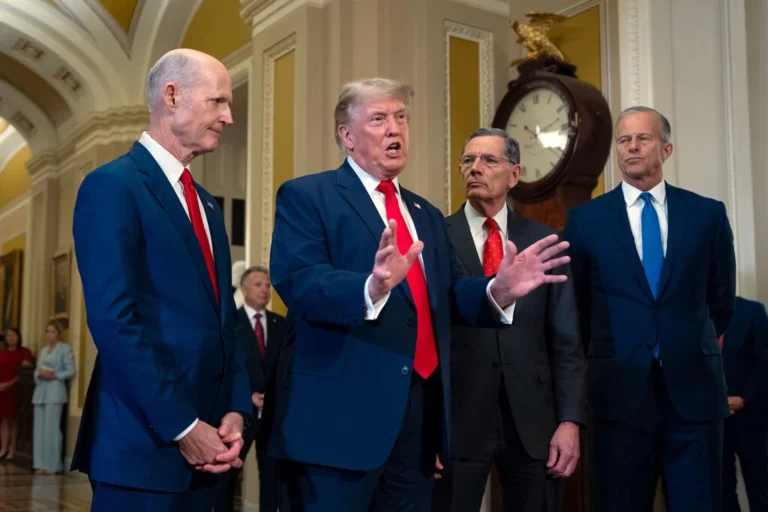
The President’s direct dismissal of the housing bill—which he characterized in subsequent social media posts as an “Elizabeth ‘Pocahontas’ Warren centric housing bill” that “pales in comparison” to election security—sparked immediate friction during his scheduled lunch meeting with Republican senators on Wednesday.
- Republican Defiance: Mainstream Senate Republicans had intended to use the housing bill as a signature economic triumph to showcase to voters ahead of the critical November midterm elections. Senate Majority Leader John Thune called it a “great piece of legislation,” adding, “It’s an affordability issue, and eventually I hope he’ll find his way to sign it.”
- Democratic Outrage: Senate Minority Leader Chuck Schumer blasted the move on the Senate floor, calling the President “petulant, angry, and ridiculous.” Schumer noted that if the President follows through with an official veto, Congress easily possesses the bipartisan numbers required to execute a historic legislative override.
- The 10-Day Clock: Despite the theater of the canceled ceremony, House Speaker Mike Johnson attempted to downplay the crisis, assuring reporters that the President simply wants to build political leverage for voter ID laws and intends to quietly sign the housing bill before the expiration of his constitutional 10-day window. Under the Constitution, if the President does not formally sign or veto the legislation within 10 days (excluding Sundays) while Congress is in session, it automatically becomes law without his signature.
Trendsetter Tribune