 By Trendsetter Tribune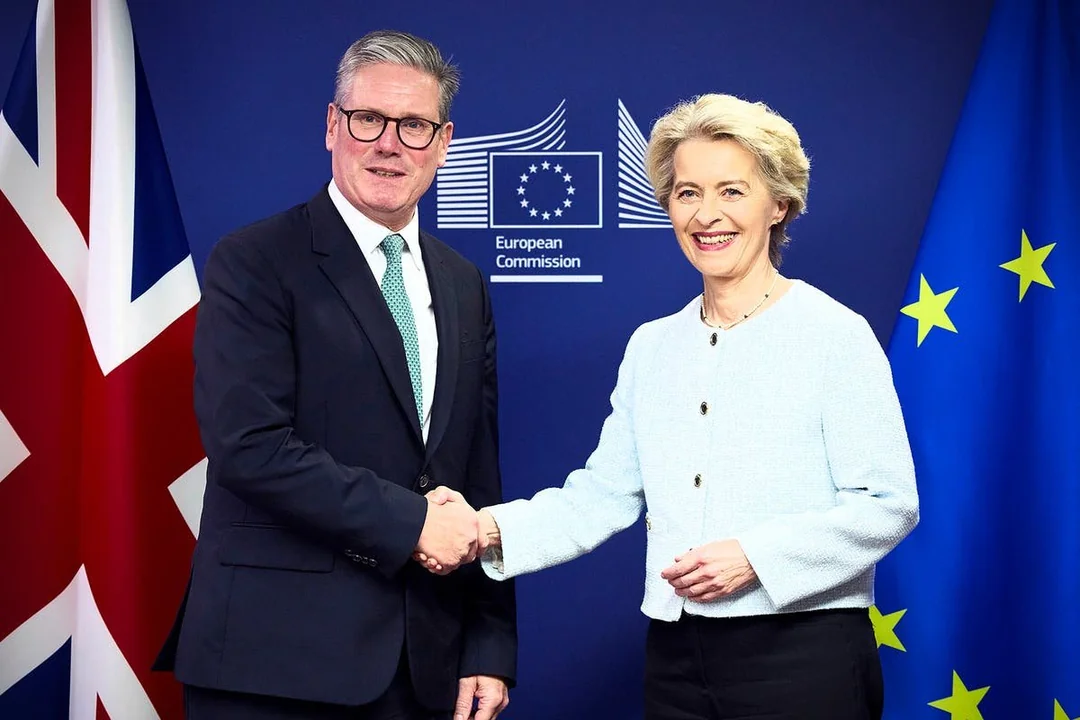
Nearly a decade after the 2016 referendum, a major diplomatic shift is unfolding as the United Kingdom and the European Union move to “exorcise the ghosts of the past.” On Tuesday, February 3, 2026, European Parliament President Roberta Metsola delivered a landmark speech to the Spanish Senate in Madrid, calling for a “realistic pragmatism” that could lead to the most significant integration of the UK into European systems since Brexit.
The move comes at a critical juncture for Prime Minister Keir Starmer, who faces a dual threat: a stagnant domestic economy and a surge in the polls for Nigel Farage’s Reform UK.
The “Farage Clause”: A Billion-Pound Deterrent
As talks on a new trade and customs pact accelerate, Brussels has introduced a controversial safeguard dubbed the “Farage Clause.” This provision is designed to protect the EU from the political volatility of Westminster.
- Financial Penalty: The clause stipulates that if a future UK government (specifically a Reform UK administration) reneges on the new alignment deals, the UK must pay billions of pounds in compensation.
- Purpose: The funds would cover the massive costs the EU would incur to reinstate border infrastructure and customs personnel that had been dismantled under the new agreement.
- Political Fallout: Nigel Farage has labeled the clause a “democratic outrage,” vowing to ignore it if elected, while Labour officials dismiss it as a “routine legal contingency” found in modern international treaties.
Accelerating Integration: Trade, Customs, and Defense
The “reset” has moved beyond aspirational rhetoric into concrete technical negotiations. Following a high-level meeting between Chancellor Rachel Reeves and EU trade chiefs on Monday, February 2, several key areas are now on the table:
- Customs Union Lite: While Starmer has officially ruled out rejoining the Customs Union, there is mounting pressure from his Cabinet to negotiate a “bespoke customs arrangement” to slash checks on goods.
- The “Four Freedoms” Dilemma: The EU remains firm: privileged access to the Single Market requires accepting the freedom of movement. Starmer is currently attempting to navigate this by proposing “enhanced mobility schemes” for researchers and young professionals rather than a full return to pre-2016 rules.
- Defense & SAFE: Starmer is pushing for UK defense firms to access the EU’s €150 billion SAFE scheme for military hardware procurement—a move currently supported by France but facing hesitation from other member states.
The Role of Spain and the Gibraltar Breakthrough
A significant hurdle to this rapprochement was cleared in June 2025 with a “historic” deal over Gibraltar.
- Schengen Status: The agreement effectively brings Gibraltar into the Schengen Area, removing the 1.2km border fence with Spain and allowing the free flow of 15,000 daily frontier workers.
- Strategic Thaw: This resolution ended years of friction between London and Madrid, allowing Prime Minister Pedro Sánchez to become one of the UK’s strongest advocates for a broader EU-UK “Strategic Bilateral Framework.”
Domestic Pressure: The Reform UK Surge
The urgency of the reset is driven by the UK’s “anaemic” economic growth, forecast at just 1.2% for 2026. With Reform UK currently polling at 29%—well ahead of the Conservatives and within striking distance of Labour—Starmer is betting that tangible economic relief from closer EU ties will neutralize Farage’s populist appeal before the 2029 election.
“It is time to exorcise the ghosts of the past, reset our partnership, and find solutions together.” — Roberta Metsola, President of the European Parliament, Feb 3, 2026.
Together with my colleague @VDombrovskis, I had valuable exchanges on geoeconomic challenges and geopolitical uncertainty with our counterparts @RachelReevesMP, @peterkyle, @NickTorfaen. Engagement with like-minded partners matters. pic.twitter.com/wvU4i1UZ7U
— Maroš Šefčovič🇪🇺 (@MarosSefcovic) February 2, 2026