 By Trendsetter Tribune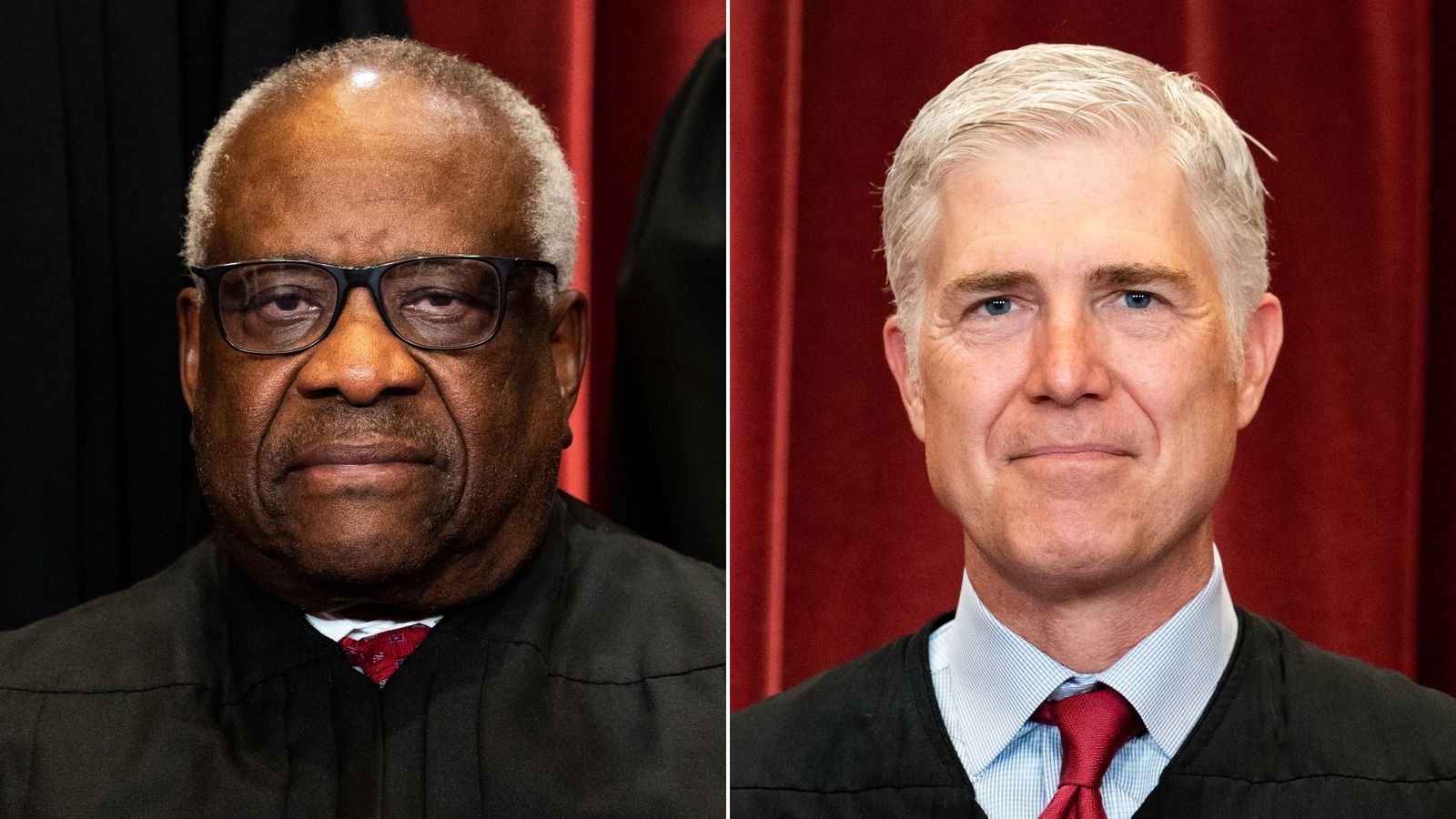
WASHINGTON — In a rare and pointed fracture within the Supreme Court’s conservative wing, Justice Clarence Thomas used his dissent on Friday, February 20, 2026, to call out Justice Neil Gorsuch over his decision to side with the court’s liberal bloc in striking down President Trump’s global tariffs.
The disagreement in Learning Resources v. Trump highlights a growing tension between two of the court’s leading originalists regarding the limits of executive power during a national emergency.
The Bone of Contention: Statutory vs. Structural Originalism
While both justices are committed to the Constitution’s original meaning, they applied that philosophy to the International Emergency Economic Powers Act (IEEPA) in fundamentally different ways:
- The Gorsuch View (The Majority/Concurrence): Justice Gorsuch joined Chief Justice Roberts and the liberal justices in a 6–3 ruling, arguing that the power to “regulate” imports does not inherently include the power to “tax.” In his concurrence, Gorsuch emphasized the “Major Questions Doctrine,” warning that if Congress wants to hand over such massive economic power to the President, it must do so with “pellucid” clarity.
- The Thomas Rebuke (The Dissent): Justice Thomas, usually an ally of Gorsuch on matters of limited government, issued a separate dissent that was notably sharp. He argued that Gorsuch and the majority were ignoring centuries of trade history where “regulation” and “taxation” were inextricably linked.
“To suggest, as my colleague does today, that the President lacks the power to levy duties as a means of ‘regulation’ is to ignore the very history that originalism seeks to honor. We cannot pick and choose which parts of the historical record suit a desire to curb the Executive.” — Justice Clarence Thomas, Feb 20, 2026
The “Major Questions” Divide
The friction also centered on the use of the Major Questions Doctrine—a legal tool Gorsuch has championed to strike down federal agency overreach.
| Feature | Gorsuch’s Stance | Thomas’s Critique |
| Doctrine Use | Essential to prevent a “Presidential tax” without Congress. | Argues it’s a “judge-made” tool being used to override clear statutory text. |
| Executive Power | Believes the President is limited by the “Non-Delegation Doctrine.” | Believes the President has broad “Article II” authority over foreign commerce. |
| History | Argues history refutes “sweeping” Presidential tariff power. | Argues history supports it as a tool of statecraft. |
A Rare Public Discord
Court observers noted that Thomas’s decision to call out Gorsuch by name is uncommon for the senior justice, who typically saves his harshest rhetoric for the court’s liberal members. The tone suggests that the high-stakes nature of the “Liberation Day” tariffs—a cornerstone of the President’s economic agenda—has created a genuine philosophical rift among the conservatives.
The Path Forward
Despite the internal squabble, the ruling stands. The administration must now find alternative legal pathways (such as Section 232 of the Trade Expansion Act) to maintain its trade barriers. Meanwhile, the legal community is buzzing over what this split says about the future of originalism: Is it a tool for restraining the executive (Gorsuch) or empowering it (Thomas)?