 By Trendsetter Tribune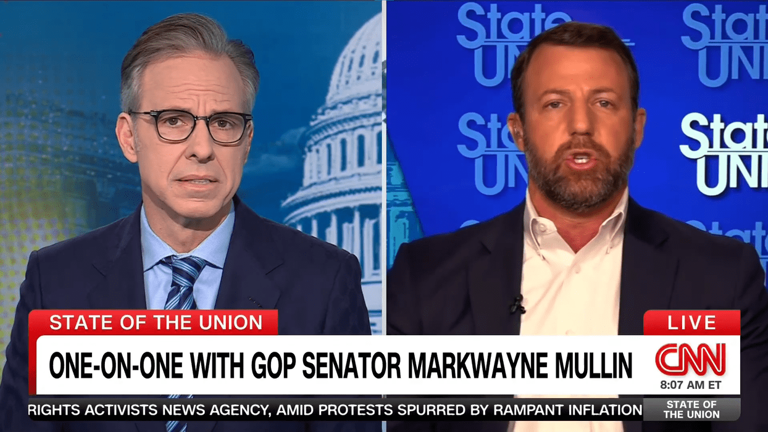
Republican Sen. Markwayne Mullin defended the fatal ICE shooting of Renee Good on CNN, only to contradict himself mid-argument as Jake Tapper challenged his shifting claims in real time.
A tense CNN appearance by Sen. Markwayne Mullin (R-OK) on Sunday turned into a live televised unraveling, as the Republican lawmaker attempted to defend the fatal shooting of Renee Good, a Minnesota woman killed by a federal immigration agent — only to contradict his own justification in real time.
The exchange, which aired on CNN’s State of the Union, underscored the growing national controversy surrounding Immigration and Customs Enforcement (ICE), use-of-force standards, and whether federal officials are applying radically different rules depending on who is involved — and who holds power.
At the center of the storm is Jonathan Ross, the ICE agent who fired three shots into Good’s vehicle during a chaotic operation in Minneapolis last Wednesday. Good died at the scene.
A Deadly Encounter Demonstrating Confusion — Not Clarity
According to accounts released by authorities and cited repeatedly in the interview, Good was sitting in her vehicle when ICE agents approached her and issued conflicting commands. One agent reportedly ordered her to “drive away,” while another demanded she “get out of the car.”
Moments later, as Ross positioned himself in front of the vehicle, Good accelerated. Ross fired three times.
The shooting has ignited protests nationwide and intensified scrutiny of ICE’s tactics — particularly after video footage appeared to show Good turning her wheels away from officers as she tried to leave the scene.
Despite those unresolved questions, Mullin arrived on CNN prepared to defend the killing unequivocally.
Mullin’s Defense — and the Moment It Fell Apart
Speaking with CNN host Jake Tapper, Mullin argued that the shooting was clearly justified because Good allegedly attempted to run down an ICE agent.
“She purposely tries to accelerate and run over…” Mullin began — before abruptly stopping himself mid-sentence.
“I don’t know if she purposely tried to run over the ICE agent,” he corrected. “But there was an ICE agent positioned in front of her vehicle. She accelerated toward them. At that point, that vehicle becomes a lethal weapon, and the agents have the right to defend themselves.”
The pivot was immediate — and damaging.
Tapper seized on the contradiction.
“You yourself just now asserted that the woman clearly tried to run over the guy,” Tapper said, “and then you said, at the very least, she was going forward while he was in front.”
Tapper pressed the core issue: intent.
“If this is disputed — if this is ambiguous — how can anyone be confident that she was trying to attack an officer rather than simply trying to flee the scene?”
It was the central question hanging over the case — and Mullin’s own words had just weakened his answer.
‘Fleeing Doesn’t Matter,’ Mullin Claims
Rather than retreat, Mullin doubled down — expanding his defense in a way that only raised more alarms.
“Fleeing the scene, it doesn’t make any difference!” Mullin insisted.
He argued that even if Good had been trying to escape — not attack — the killing was still justified.
“At that point, she hit an ICE agent,” Mullin claimed. “And hence, law enforcement enforcing our nation’s laws had the right to defend themselves.”
Tapper did not let the statement stand unchallenged.
The implication was sweeping: any attempt to flee law enforcement in a vehicle could be treated as a lethal threat, regardless of intent, conflicting commands, or video evidence.
The ‘Paid Protester’ Claim — Without Evidence
Mullin then went a step further, introducing a claim that immediately drew pushback.
“Those that are paying for professional protesters to obstruct the justice of law enforcement,” he said, “they need to start being held accountable.”
Tapper cut in sharply.
“We don’t know that she was being paid.”
The exchange highlighted a familiar pattern in modern political discourse: suggesting dark, organized conspiracies without evidence, particularly when defending controversial law enforcement actions.
At no point has any authority suggested Good was a paid protester, nor that she was part of any organized obstruction effort.
A Larger Pattern of Double Standards
Mullin’s CNN appearance comes amid intensifying scrutiny of how federal officials — and Republican leaders — respond to violence involving law enforcement.
Just hours earlier, Homeland Security Secretary Kristi Noem faced similar questions on CNN after being confronted with Jan. 6 Capitol riot footage. When asked whether Capitol Police would have been justified in shooting rioters who violently attacked them, Noem’s responses appeared to clash with the reality that President Donald Trump later pardoned every Jan. 6 defendant.
The contrast has not gone unnoticed.
Critics argue that the administration has adopted a two-tiered system: one standard for ICE and federal officers, another for politically aligned protesters.
ICE, Accountability, and Public Trust
The Renee Good shooting has become a flashpoint not only because of the fatal outcome, but because of what it reveals about ICE operations:
- Conflicting commands issued in high-stress encounters
- Agents positioning themselves in front of moving vehicles
- Lethal force used within seconds
- Federal investigations removing local authorities from oversight
The U.S. Attorney’s Office reportedly cut local agencies out of the joint investigation just one day after the shooting, leaving federal investigators solely in charge — a move that has fueled distrust and protest.
Tapper’s Core Argument: Ambiguity Matters
Throughout the interview, Tapper returned to one central point: ambiguity cannot justify certainty.
When intent is disputed, video evidence appears contradictory, and even defenders cannot consistently describe what happened, blanket declarations of justification become untenable.
“You’re illustrating exactly why this incident is widely disputed,” Tapper said in essence — a sentiment echoed by civil rights groups, local officials, and legal experts.
Why This Moment Resonates
Mullin’s on-air contradiction resonated not because it was dramatic television — but because it captured the heart of the national debate:
- Who gets the benefit of the doubt?
- When does fleeing become a death sentence?
- And why does accountability seem optional depending on the agency involved?
As protests continue and investigations unfold, the Renee Good case is shaping up to be a defining test of federal law enforcement accountability — and of whether political loyalty overrides factual consistency.
On CNN, @SenMullin corrects himself in real time while asserting Renee Good "purposely" tried to "run over" ICE agent Jonathan Ross.@jaketapper calls out the slip up, to which Mullin says "it doesn't make any difference" whether she was attempting to flee or not. pic.twitter.com/nQrR9qu8T8
— Alexander Willis (@ReporterWillis) January 11, 2026
Conclusion
Sen. Markwayne Mullin went on CNN to defend a killing he described as clear-cut. He left having demonstrated the opposite.
By contradicting himself mid-sentence, dismissing intent as irrelevant, and floating unsupported claims about “paid protesters,” Mullin didn’t strengthen the case for ICE — he exposed the fragility of its defense.
And thanks to live television, the contradiction is now part of the record.