 By Trendsetter Tribune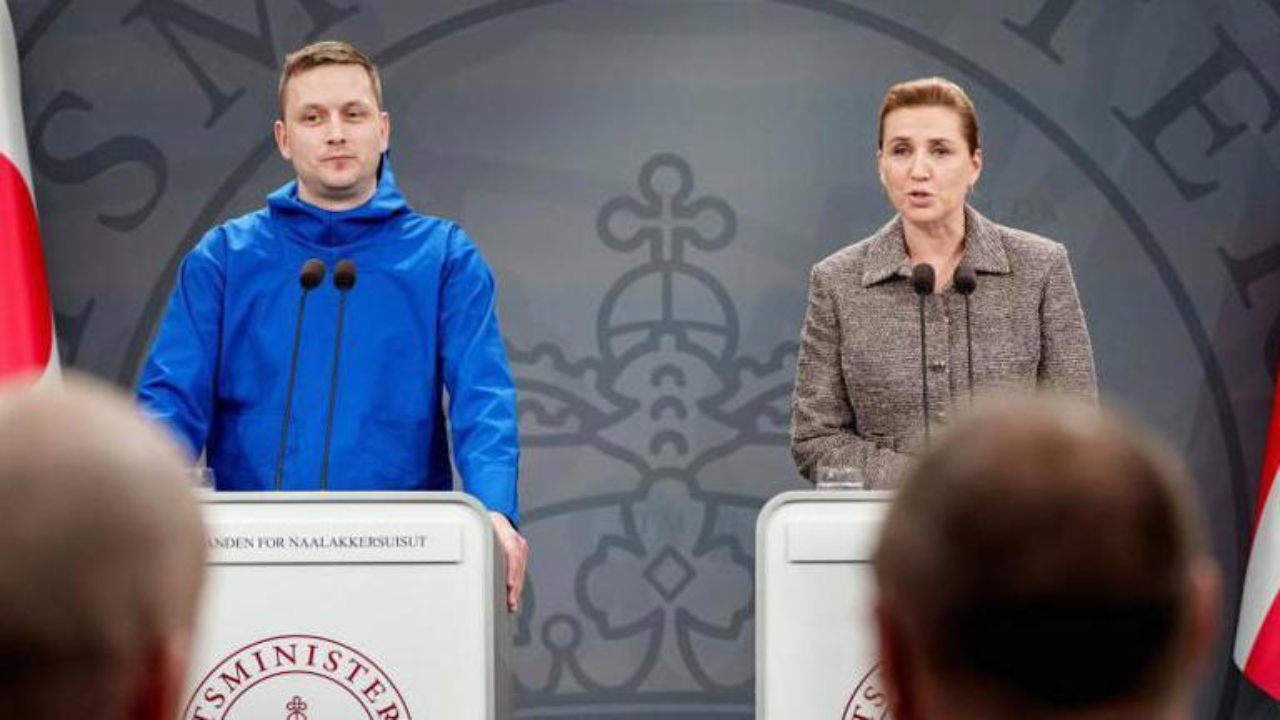
Greenland’s prime minister Jens-Frederik Nielsen says the semi-autonomous territory would choose Denmark — not the United States — in response to renewed U.S. interest in acquiring the island amid wider geopolitical tensions.
Greenland’s prime minister Jens-Frederik Nielsen delivered a forceful message this week: if Greenland had to pick between the United States and Denmark here and now, it would choose Denmark.
In a joint press conference in Copenhagen with Danish Prime Minister Mette Frederiksen, Nielsen said the semi-autonomous Arctic territory is facing a “geopolitical crisis” and reaffirmed that Greenlanders do not want to be governed or owned by the United States under any circumstances.
Strong Language at Press Conference
“If we have to choose between the United States and Denmark here and now, we choose Denmark,” said Nielsen, emphasizing that Greenland does not want to be “owned” or “governed” by the U.S. and does not want to be part of the United States.
The remarks come amid renewed controversy over U.S. interest in acquiring or asserting greater control over Greenland, sparked by comments from U.S. President Donald Trump about the island’s strategic importance for national security.
Background: Trump’s Comments and Strategic Interest
Trump has repeatedly argued that the U.S. needs Greenland for national security, pointing to its strategic Arctic location and potential threats from Russia and China. He has even floated the idea of buying the territory or otherwise strengthening U.S. control—a stance that Greenlandic and Danish leaders have sharply rejected as inappropriate and disrespectful.
Under current agreements between Denmark and the United States, Washington already has broad rights to station military forces in Greenland, including the major base at Pituffik in the northwest. However, Greenlandic and Danish officials insist that these arrangements do not amount to transfer of sovereignty.
Danish Support and NATO Backing
Prime Minister Mette Frederiksen backed Nielsen’s remarks, condemning any notion of purchasing or annexing Greenland as “completely unacceptable pressure from our closest ally.” European NATO partners, including Canada and major EU countries, have issued statements reaffirming that only Denmark and Greenland can decide their own future and that Greenland’s sovereignty must be respected.
Frederiksen also stressed the importance of cooperation on Arctic security that includes the U.S. and NATO — but on terms that respect Greenland’s status and Denmark’s sovereignty.
Broader Geopolitical Context
Greenland’s position — straddling the Arctic and North America — makes it a significant focal point for global security discussions. As ice melts and new shipping routes and mineral interests emerge, the island’s strategic importance has grown. Copenhagen and Nuuk both insist that their alliance with the U.S. is vital, but sovereignty and self-determination are nonnegotiable for Greenlanders.
Recent meetings have been arranged between Danish and Greenlandic officials and senior U.S. counterparts — including Vice President JD Vance and Secretary of State Marco Rubio — to defuse tensions and reaffirm cooperation.
What Greenlanders Want
Polls and statements from political leaders on the island make clear that most Greenlanders oppose any U.S. takeover and prefer to retain ties with Denmark — or pursue greater independence — rather than be part of the United States.
Greenland’s government and party leaders have repeatedly emphasized that decisions about the island’s future must be made by Greenlanders themselves, not imposed by outside powers.
Conclusion: Firm Lines in the Arctic
Nielsen’s declaration that Greenland would choose Denmark over the United States “here and now” underscores how sharply the Greenlandic government has pushed back against suggestions of U.S. ownership or governance. While cooperation on defense and security will continue, Greenland’s leaders have drawn a firm line on sovereignty.
The developments have broad implications not only for Arctic geopolitics but also for NATO alliances and U.S. foreign policy in the region — particularly as strategic competition with Russia and China intensifies.