 By Trendsetter Tribune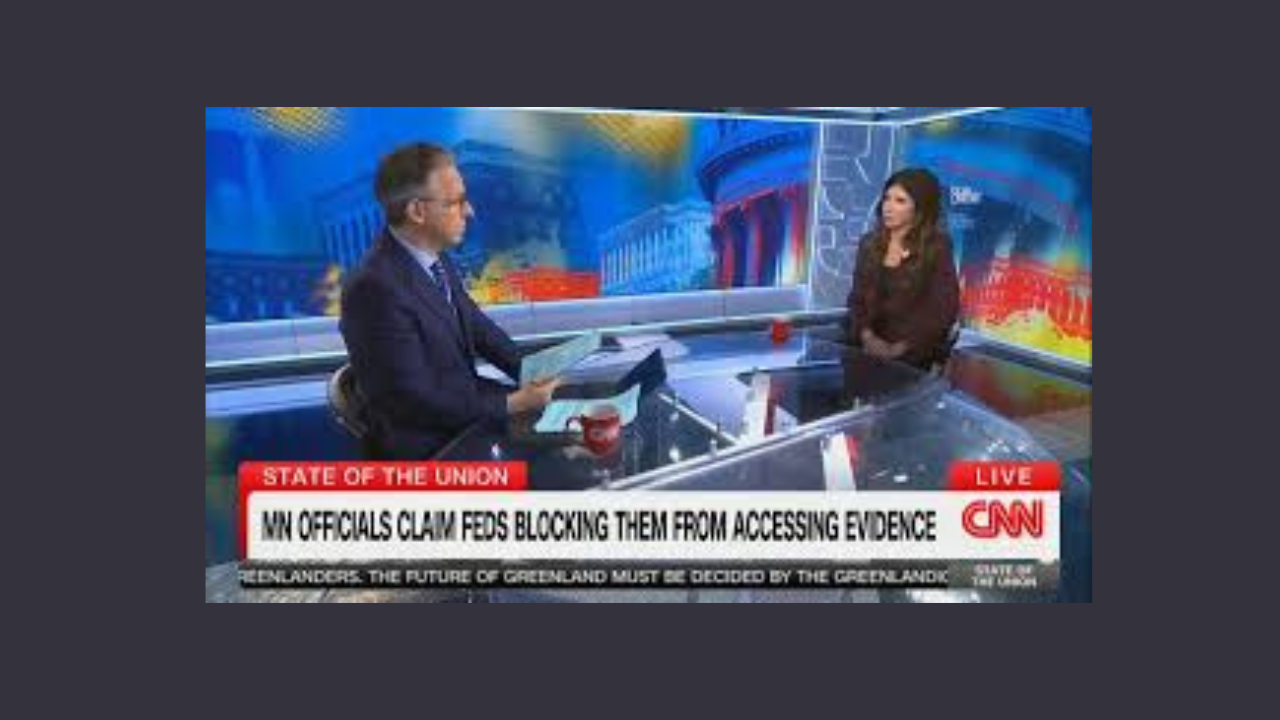
DHS Secretary Kristi Noem struggled to defend ICE after CNN’s Jake Tapper confronted her with Jan. 6 riot footage, exposing what critics call a glaring double standard in how Trump allies treat violence against law enforcement.
Kristi Noem didn’t expect the interview to end this way.
After nearly an hour of tense back-and-forth on immigration enforcement, protests, and the fatal shooting of Renee Macklin Good by an ICE agent in Minneapolis, CNN’s Jake Tapper closed State of the Union with a move that visibly rattled the Department of Homeland Security secretary: he pressed play on footage from January 6, 2021.
What followed was an on-air moment that cut straight to one of the most explosive political fault lines in America—who gets excused for attacking law enforcement, and who doesn’t.
“By This Standard, Would They Be Justified in Killing?”
As images of Capitol Police officers being beaten, shoved, and overrun by rioters filled the screen, Tapper posed a blunt question.
“Those are law enforcement officers being physically attacked,” he said. “By this standard, would any of those officers be justified in shooting and killing the people causing them physical harm?”
The question directly challenged Noem’s defense of the ICE officer who shot and killed Good during an operation in Minneapolis—an incident DHS officials have repeatedly framed as justified self-defense despite video evidence suggesting Good was attempting to drive away.
Noem’s response raised eyebrows.
“Every single situation is going to rely on the situation those officers are on,” she said. “But they know that when people are putting hands on them, when they are using weapons against them, when they’re physically harming them, that they have the authority to arrest those individuals.”
Not shoot them.
Not kill them.
Arrest them.
The Pardon Problem
Tapper didn’t let it slide.
“The president pardoned every single one of those people,” he said, referring to Donald Trump’s sweeping pardons of all Jan. 6 rioters—including individuals convicted of violently assaulting Capitol Police officers.
That contrast—between unarmed protesters beaten and jailed, and rioters who attacked officers and were later pardoned—has become politically radioactive.
Noem attempted to deny any double standard.
“Every single one of these investigations comes in the full context of the situation on the ground,” she said, insisting that under Trump, “every single [law] is being enforced.”
Tapper’s reaction was unmistakable disbelief.
“I just showed you video of people attacking law enforcement officers,” he shot back. “Undisputed proof, undisputed evidence. And I just said President Trump pardoned all of them. And you said that President Trump is enforcing all the laws equally. It’s just not true.”
A Moment of Evasion
Cornered, Noem pivoted—hard.
Rather than address the pardons or explain why Jan. 6 attackers faced clemency while critics of ICE face prosecution, she shifted into broad talking points about targeting “the worst of the worst” and enforcing the law “factually.”
“This individual, and these instances, and these investigations all have to be taken and done correctly in context,” Noem said, never directly answering the central charge of unequal enforcement.
For critics, the evasion was the answer.
ICE, Minneapolis, and a Nation on Edge
The exchange comes as the killing of Renee Macklin Good, a 37-year-old woman shot by an ICE officer in Minneapolis, has sparked nationwide protests and renewed scrutiny of immigration enforcement tactics.
Federal officials, including Noem and White House border czar Tom Homan, have defended the officer’s actions as a “split-second decision,” while local officials have pointed to video showing Good turning her vehicle away from officers.
The FBI is now solely handling the investigation after local agencies were cut out—a move that has only deepened public skepticism.
Against that backdrop, Tapper’s Jan. 6 comparison struck a nerve.
Two Americas, Two Rules
To critics, the contradiction is stark:
- Capitol Police were violently attacked on Jan. 6
- Rioters were later pardoned en masse
- ICE officers receive blanket institutional defense
- Protesters and civilians face harsh enforcement
“There’s a different standard for law enforcement officials being attacked if they’re being attacked by Trump supporters,” Tapper said bluntly.
Noem had no direct rebuttal.
Political Fallout
The moment has already ricocheted across social media, with civil rights groups, immigration advocates, and legal analysts accusing the Trump administration of selectively defending law enforcement based on politics—not principle.
Supporters of Noem argue that ICE officers face unique dangers and that Jan. 6 was a singular political event. But critics counter that the rule of law cannot be situational without losing legitimacy.
“If you pardon people who beat police officers,” one former federal prosecutor said, “you lose the moral authority to claim ‘back the blue’ elsewhere.”
Why This Moment Matters
The Noem–Tapper exchange distilled years of political tension into a single, uncomfortable truth: law enforcement is being weaponized rhetorically while selectively protected legally.
And when pressed with visual evidence—raw, undeniable footage—Noem could not reconcile the contradiction.
For millions of viewers, the takeaway was simple and unsettling:
If violence against police is unforgivable—
why was it forgiven when it came from Trump supporters?
Conclusion
Kristi Noem walked into State of the Union prepared to defend ICE. She walked out having unintentionally reopened the wound of January 6—and the unresolved question at the heart of American politics today.
Is the law enforced equally?
Or only when it’s politically convenient?
On live television, confronted with the receipts, the answer was left hanging—unspoken, but painfully clear.