 By Trendsetter Tribune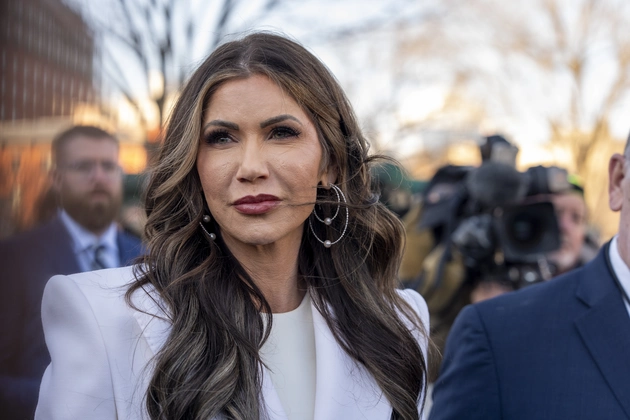
Homeland Security Secretary Kristi Noem quietly rolled out a new policy restricting congressional visits to ICE detention facilities—revealed in court just days after a fatal ICE shooting in Minneapolis sparked nationwide outrage.
Homeland Security Secretary Kristi Noem has quietly imposed sweeping new restrictions on congressional oversight of immigration detention facilities, a move revealed in court late Saturday that immediately ignited accusations of obstruction, lawlessness, and a coordinated federal crackdown on accountability.
The policy surfaced only after three Minnesota Democratic lawmakers were physically blocked from entering an ICE detention facility in downtown Minneapolis—just days after an ICE agent fatally shot 37-year-old Renee Nicole Good, a killing that has sparked protests, public fury, and demands for ICE to leave the city altogether.
Critics say the timing is no coincidence.
Lawmakers Blocked Without Warning
On Saturday morning, Reps. Ilhan Omar, Angie Craig, and Kelly Morrison arrived at the ICE processing center inside the Whipple federal building in Minneapolis to conduct an oversight visit and check on detainee conditions.
They were initially allowed inside—then abruptly ordered to leave.
According to the lawmakers, they were never informed of a policy change requiring advance notice. That change, they later learned, had quietly gone into effect two days earlier, on Thursday, and mandates that members of Congress provide at least one week’s notice before visiting ICE detention facilities.
The policy was only disclosed publicly after it was referenced in court filings late Saturday.
A Policy That Defies a Federal Judge
The new restriction directly conflicts with a federal court ruling issued just last month. U.S. District Judge Jia Cobb ruled that federal spending laws require ICE to allow unrestricted congressional access to detention facilities—without advance notice—explicitly rejecting a similar policy attempt.
Noem, however, appears to be attempting an end-run around that ruling.
Her order specifies that the policy must be implemented exclusively using funds appropriated through President Donald Trump’s One Big Beautiful Bill Act (OBBBA)—not standard congressional appropriations—an argument her department claims allows DHS to sidestep federal spending laws.
Legal experts and Democratic lawmakers say the maneuver is legally dubious at best—and openly defiant at worst.
“This is complete nonsense,” Rep. Angie Craig said Saturday. “I informed them they were violating the law. They said they didn’t care.”
Fallout From a Fatal ICE Shooting
The policy change comes amid mounting national backlash against ICE, particularly in blue cities and states, following the fatal shooting of Renee Nicole Good by an ICE agent in Minneapolis earlier this week.
Federal officials—including Vice President JD Vance and Noem—have rushed to defend the agent, insisting the killing was an act of self-defense.
Minnesota’s Democratic leadership has flatly rejected that claim, pointing to evidence suggesting Good posed no imminent threat when the agent fired three shots.
The killing has triggered large-scale protests, calls for ICE to withdraw from Minneapolis, and intensified scrutiny of ICE operations nationwide.
Against that backdrop, critics say restricting congressional access looks less like bureaucracy—and more like damage control.
Democrats Cry Obstruction
Members of Congress from across the country reacted swiftly and angrily.
“Members of Congress have a legal right and constitutional responsibility to conduct oversight where people are being detained,” Rep. Ilhan Omar wrote on X after being denied entry. “The public deserves to know what is taking place in ICE facilities.”
“This was a blatant attempt to obstruct members of Congress from doing their oversight duties,” Omar later told reporters.
Rep. Kelly Morrison echoed the concern: “Minnesotans—and all Americans—deserve transparency. We are going to keep fighting for transparency, accountability, and the rule of law.”
Colorado Rep. Joe Neguse went further, vowing immediate legal action.
“This policy is a clear attempt to subvert the ruling in Neguse et al. vs. ICE et al., issued just three weeks ago,” he wrote. “We will challenge it in court immediately.”
Even Conservatives Raise Red Flags
The backlash has not been limited to Democrats.
Matt Rice, Washington correspondent for The New York Sun, noted that a federal law—signed by President Trump himself—explicitly grants members of Congress the right to visit DHS detention facilities at any time.
“Lawmakers have the right to show up whenever they see fit,” Rice wrote.
That contradiction has only deepened concerns that the administration is knowingly operating outside established legal boundaries.
FBI Pulls Back as Tensions Rise
Compounding the controversy, the FBI has reportedly withdrawn its offer to cooperate with Minnesota authorities investigating Good’s death, further inflaming distrust between federal and state officials.
When asked whether the FBI should share evidence, Trump accused Minnesota’s leadership of being “crooked,” referencing an unrelated fraud case involving child care centers—a remark critics called inflammatory and irrelevant.
The move has fueled accusations that the federal government is closing ranks around ICE while shutting out oversight at every level.
A Broader Pattern
Civil liberties advocates say Noem’s order fits a broader pattern under the Trump administration: aggressive immigration enforcement paired with shrinking transparency and oversight.
“Blocking Congress from detention centers while defending a deadly shooting is not a coincidence—it’s a strategy,” said one immigration policy analyst. “If there’s nothing to hide, why lock the doors?”
What Comes Next
Legal challenges appear inevitable. Democratic lawmakers are preparing court filings arguing that Noem’s policy violates both federal law and constitutional separation of powers.
For now, the new rule remains in effect, forcing members of Congress to seek permission—a full week in advance—to visit facilities where immigrants are detained by the federal government.
Conclusion
Kristi Noem’s quiet policy shift has detonated a political firestorm, raising urgent questions about transparency, accountability, and the rule of law. Coming just days after a fatal ICE shooting and amid nationwide protests, the decision to block congressional oversight has only intensified suspicion and outrage.
As court battles loom and public anger grows, one thing is clear: the fight over ICE—and who gets to watch it—has entered a dangerous new phase.