 By Trendsetter Tribune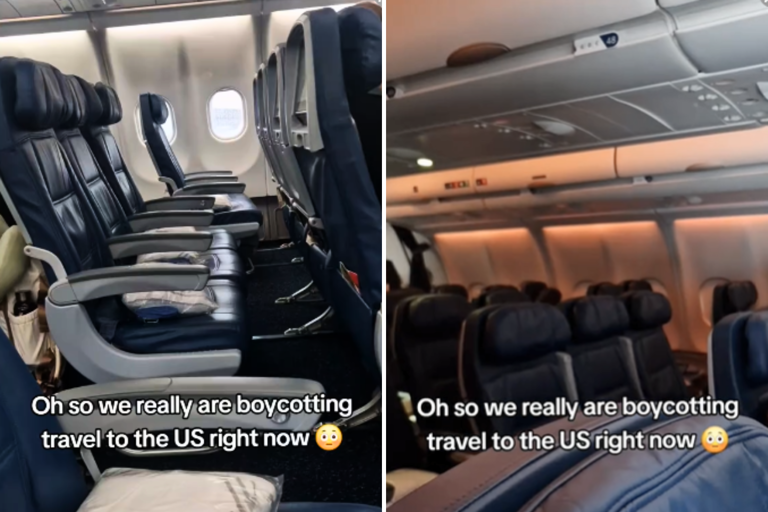
A viral TikTok video showing an unusually empty Delta Air Lines flight from London to New York has ignited online debate about whether international travelers are increasingly avoiding the United States. While airlines point to seasonal travel patterns, the clip has resurfaced broader concerns about U.S. entry policies, heightened screening, and shifting global perceptions of American travel.
The video, posted by a British traveler named Megan, shows the cabin of a Delta flight from London Heathrow to New York’s JFK Airport appearing largely vacant. The clip, filmed aboard a January 13, 2026 departure, was captioned: “Oh so we really are boycotting travel to the U.S. right now,” followed by, “Weirdest flight ever.”
The short video quickly spread across TikTok, drawing thousands of comments speculating about the reason for the low passenger count.
Megan later said she did not initially see the empty flight as political or policy-related.
“I was delighted the flight was empty as no one sat next to me,” she said. “I thought maybe the flight was empty because it’s January, when NYC is so cold, and didn’t think much more of it.”
Airline response and seasonal context
Delta Air Lines acknowledged the video but downplayed the significance of the empty cabin.
“While a rare sight, we hope our customers enjoyed the flight,” a Delta spokesperson said. “New York to London remains one of the most-transited international markets in the world.”
January is traditionally a slower month for transatlantic leisure travel, following the holiday season and coinciding with winter weather in the northeastern United States. Industry analysts note that lighter passenger loads during this period are not unusual.
Still, the timing of the viral clip has amplified speculation that broader forces may be influencing travel behavior.
Growing scrutiny of U.S. entry policies
Some viewers pointed to heightened concern over U.S. border enforcement and entry procedures, particularly under policies prioritizing immigration scrutiny.
Earlier this year, the United Kingdom updated its travel guidance for citizens visiting the United States. The advisory warned that travelers “may be liable to arrest or detention if they break the rules” at U.S. ports of entry—language that has drawn attention for being more explicit than in previous advisories.
Several European countries, including Germany, Finland, and Denmark, have also revised their guidance in recent months, emphasizing that possession of a visa or travel authorization does not guarantee entry and that travelers should expect increased screening.
The Trump administration has additionally proposed expanding disclosure requirements for tourists, including those from visa-waiver countries such as the United Kingdom. Under the proposal, applicants for the Electronic System for Travel Authorization (ESTA) could be required to provide up to five years of social-media history.
Social media reactions reflect mixed sentiment
Commentary surrounding the viral video has ranged from lighthearted jokes to serious concern about visiting the United States.
“Why would I pay the journey just to get my social media checked and get sent back?” one commenter wrote.
“My social media history prohibits me from visiting the US. Proud,” another said.
Other users described canceling trips altogether, citing safety fears or uncertainty at U.S. borders.
“We’ve cancelled our trip. It’s a war zone out there. Why risk it?” one viewer claimed, while another added: “Honestly, boycott aside, why would you want to go?”
While such comments may reflect exaggeration or online hyperbole, they highlight a growing perception problem for U.S. tourism.
Analysis: Perception versus reality
There is no data indicating a coordinated boycott of U.S. travel, and major international routes continue to operate at scale. However, the viral response suggests that traveler confidence is increasingly shaped by anecdotal experiences, policy headlines, and social media narratives rather than official statistics alone.
Even isolated incidents—such as travelers being denied entry based on device searches or social-media content—can have an outsized impact on public perception, especially when amplified online.
For airlines, tourism officials, and U.S. policymakers, the challenge may be less about actual travel volumes and more about restoring reassurance to foreign visitors navigating an evolving enforcement landscape.
Implications for U.S. tourism
If uncertainty around entry policies persists, it could gradually influence discretionary travel decisions, particularly among leisure travelers from Europe who have multiple alternative destinations.
While winter seasonality likely explains the near-empty Delta flight, the viral clip underscores how quickly routine travel anomalies can become symbolic of broader political and cultural anxieties.
Conclusion
The sight of a sparsely filled transatlantic flight has sparked an outsized conversation about travel to the United States, blending seasonal travel realities with growing unease over border scrutiny. Whether the viral moment reflects a temporary curiosity or a deeper shift in global travel sentiment remains unclear, but it highlights how perception, policy, and social media now intersect in shaping international tourism decisions.