By Trendsetter Tribune
The Nigeria Police Intelligence Response Team summons ex-Rivers SSG Tammy Danagogo over a leaked audio allegedly plotting to kill FCT Minister Wike, exposing the government’s shadowy political games.
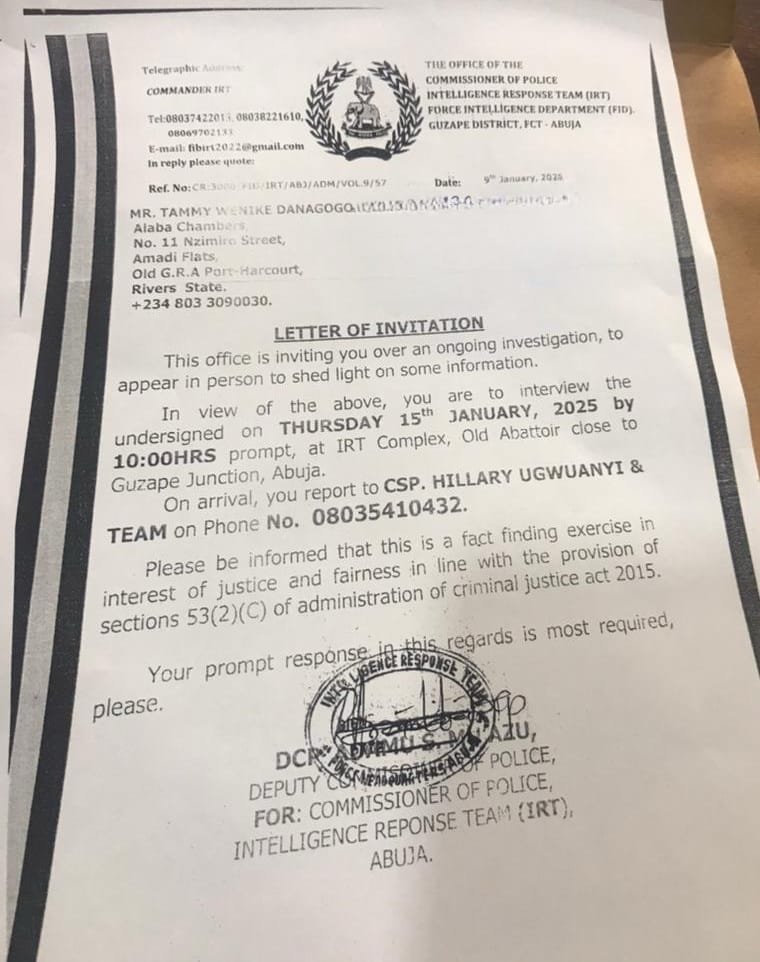
The Nigeria Police Force has once again shown how its “justice” apparatus can be used as a tool for political intimidation. The Intelligence Response Team (IRT) summoned former Rivers State Secretary to the Government (SSG) Tammy Wenike Danagogo to Abuja, citing a leaked phone conversation allegedly linked to a plot to assassinate FCT Minister Nyesom Wike.
The invitation, dated January 9, demanded Danagogo’s presence on Thursday, January 15, at the IRT complex in Guzape, Abuja. While police described the summons as a “fact-finding exercise in the interest of justice and fairness,” the timing and political context suggest this is anything but neutral enforcement.
Danagogo, a close ally of Rivers Governor Siminalayi Fubara, has reportedly gone underground, fearing for his safety as the investigation unfolds. Sources say the police move stems from a viral leaked audio allegedly revealing a plan to hire Israeli nationals to eliminate Wike, allegedly with funding sought from Governor Fubara.
Already, the IRT has arrested Dr. Tombari Joseph Gbeneol, a Port Harcourt–based pastor and medical doctor, over the same plot. Security operatives claim the intercepted conversation between Gbeneol and Danagogo constituted a “grave national security threat.”
The details are murky, and the police have declined to name the suspects or reveal evidence, keeping the public in the dark while the investigation drags on. This raises serious questions about transparency, accountability, and political bias in Nigeria’s law enforcement system.
Observers note that in a state riddled with political vendettas, arrests like these often serve to send messages rather than deliver justice, especially when high-profile figures and election rivals are involved. Danagogo’s disappearance highlights the precarious position of political insiders in a system where law enforcement is entwined with partisan power struggles.
The situation exposes not just a potential criminal conspiracy but also the fragility of Nigeria’s rule of law, where police actions can easily blur the lines between legal enforcement and political theater.