 By Trendsetter Tribune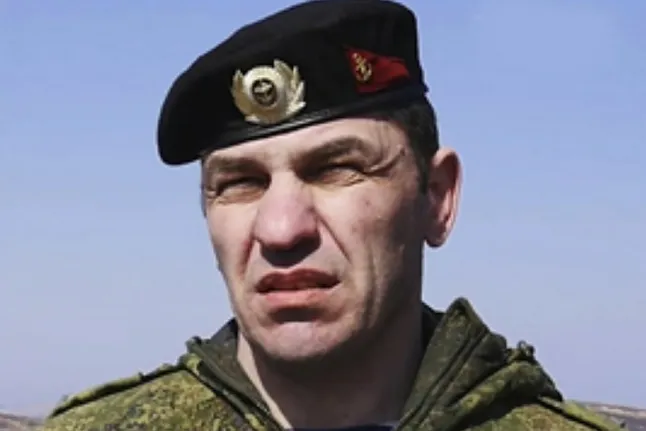
Russian President Vladimir Putin has removed Lieutenant General Sukhrob Akhmedov from his senior naval post amid mounting criticism over deadly battlefield failures in Ukraine and growing pressure on Russia’s military leadership.
Russian President Vladimir Putin has dismissed one of his most highly decorated military commanders amid intensifying scrutiny of Russia’s war effort in Ukraine. The removal of Lieutenant General Sukhrob Akhmedov follows some of the deadliest and most controversial Russian battlefield failures of the war, highlighting growing internal dissatisfaction as losses mount and pressure spreads from the front lines into Russian territory itself.
The decision underscores a deeper crisis within Russia’s military command structure, where loyalty has often been rewarded over competence — a dynamic now increasingly difficult to sustain as the war drags on.
Background: A once-favored commander
Lieutenant General Sukhrob Akhmedov, 51, had been serving as deputy commander-in-chief of the Russian Navy for Coastal and Land Forces, a senior role overseeing key ground and amphibious operations.
Until recently, Akhmedov was widely regarded as a trusted figure within the Kremlin. Putin personally awarded him Russia’s highest military honor, the “Hero of Russia” medal, reportedly for operations in the Kursk region last year.
That recognition made his sudden removal particularly striking, signaling a rare reversal for a commander once seen as politically protected.
What led to Akhmedov’s dismissal
Akhmedov has been openly blamed for a failed mechanized marine assault near Pokrovsk in occupied eastern Ukraine late last year — an operation that Russian critics have described as both disastrous and unnecessary.
According to battlefield accounts and footage circulated online, Russian armored units advanced into exposed terrain and were rapidly destroyed by Ukrainian forces. Tanks burned, armored vehicles were disabled, and surviving soldiers documented the aftermath, fueling outrage among Russian military bloggers and families of conscripts.
The Pokrovsk assault became emblematic of broader criticisms that Russian commanders continue to order frontal attacks with little regard for casualties.
Earlier incident near Kremenna
The Pokrovsk failure was not the first major controversy tied to Akhmedov’s command.
He was also blamed for a deadly incident in June 2023 near Kremenna, where Russian soldiers were reportedly ordered to stand in formation in an open area for hours while awaiting what was described as a “motivational speech.”
Ukrainian artillery reportedly detected the gathering and struck the formation, killing dozens of soldiers.
The influential Russian military Telegram channel Rybar wrote that Akhmedov and other commanders bore responsibility for the deaths but were shielded at the time by internal favoritism.
“Given the nepotism that was flourishing in the court-based Western Military District at that time, this matter was swept under the rug,” the channel said.
Growing anger within Russian ranks
For many Russian soldiers and pro-war commentators, Akhmedov’s rise — and eventual fall — has come to symbolize what they view as systemic dysfunction within Russia’s armed forces.
The “Hero of Russia” title, once intended to represent battlefield excellence, has increasingly been criticized as a political reward disconnected from performance. Critics argue that incompetence is tolerated, or even promoted, as long as loyalty to the Kremlin remains intact.
Akhmedov’s dismissal may reflect an effort by the Kremlin to deflect blame downward as frustrations over the war continue to grow.
Wider battlefield struggles
Russia’s military continues to face heavy losses as it attempts to seize additional Ukrainian territory. Ukrainian forces have intensified long-range strikes, including attacks on Russian border regions.
In Belgorod, which borders Ukraine, regional governor Vyacheslav Gladkov warned residents to prepare for possible evacuation as Ukrainian strikes continued.
According to regional officials, attacks have left more than half a million people without electricity and nearly 200,000 without water and sewerage services. Mobile networks were also partially disrupted, with authorities acknowledging more than 60 percent degradation in cellular service despite regulations requiring backup power systems.
Gladkov described the situation as unprecedented for the region.
Analysis: A rare crack in the system
While Russian commanders have been replaced before, the removal of a general so closely associated with Putin is notable. It suggests the Kremlin may be under increasing pressure to demonstrate accountability, even if structural issues remain unresolved.
However, analysts caution that individual firings are unlikely to produce meaningful change. Many of the operational failures cited in Akhmedov’s case — rigid command structures, poor intelligence integration, and disregard for troop safety — are deeply embedded within the Russian military system.
The move may therefore serve more as a political signal than a strategic reset.
Implications going forward
Akhmedov’s dismissal comes as Russia faces mounting domestic strain from casualties, infrastructure disruptions, and the expanding reach of the war into its own territory.
Whether the decision marks the beginning of broader accountability within Russia’s military leadership remains uncertain. For now, it highlights the growing cost of a war that shows no sign of ending — and the increasing difficulty of insulating senior commanders from its consequences.
Conclusion
The firing of Lieutenant General Sukhrob Akhmedov marks a rare and telling moment in Russia’s war in Ukraine. Once celebrated as a hero, he has now become a symbol of mounting frustration over battlefield failures and human cost.
As Russia’s military struggles persist and pressure intensifies at home and abroad, the dismissal underscores a sobering reality for the Kremlin: loyalty alone may no longer be enough to shield commanders from the consequences of a grinding and costly conflict.