 By Trendsetter Tribune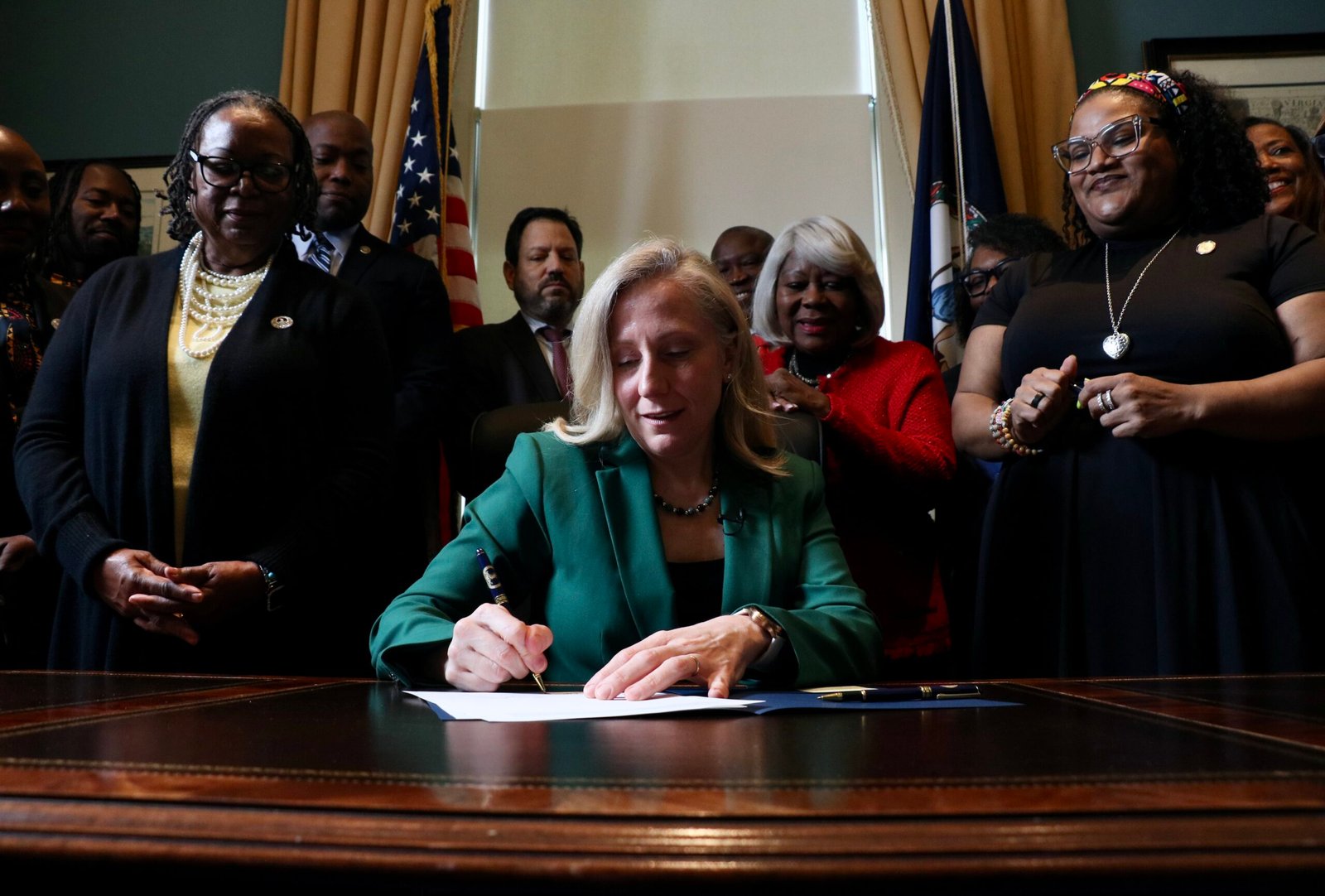
RICHMOND, VA — Virginia Governor Abigail Spanberger signed a high-stakes budget bill late Friday night, February 20, 2026, that includes a new congressional map designed to give Democrats a commanding 10-1 advantage in the state’s delegation. The move is a direct “counter-offensive” to mid-decade redistricting efforts in Republican-led states like Texas and North Carolina, which have already moved to shore up GOP control of the U.S. House.
The bill, HB 29 (known as the “caboose bill”), provisionally approves a map that would shift four current Republican-leaning or competitive districts into the Democratic column, potentially netting the party four additional seats in the 2026 midterms.
The Map: From 6-5 to 10-1
Virginia’s current delegation is split 6 Democrats and 5 Republicans. The new boundaries, drawn by the Democratic-controlled General Assembly, would leave only one “solid red” stronghold in the southwest corner of the state (District 9, held by Rep. Morgan Griffith).
| Target District | Current Representative | Proposed Change |
| District 1 | Rob Wittman (R) | Carved into more Democratic-leaning areas in Fairfax and Prince William counties. |
| District 2 | Jen Kiggans (R) | Shifted to include more of Chesapeake; based on 2025 results, it would favor Democrats by 12.6 points. |
| District 5 | Bob Good (R) | Redrawn to include more liberal urban corridors, shifting it toward a Democratic lean. |
| District 6 | Ben Cline (R) | Reconfigured to include areas where Spanberger won by over 10 points in the 2025 gubernatorial race. |
The Legal Stalemate: “A Massive Win” for the GOP?
Despite Spanberger’s signature, the map’s implementation is currently blocked by the courts. On Thursday, February 19, Tazewell County Circuit Judge Jack S. Hurley Jr. issued an injunction halting the process.
- The Injunction: Judge Hurley ruled in favor of the RNC and NRCC, blocking a planned April 21 special referendum that would ask voters to authorize this mid-decade remapping.
- The “Technicality”: The judge previously found that the constitutional amendment was introduced in violation of state law because it was taken up too close to an intervening election.
- The Appeal: Attorney General Jay Jones filed an immediate appeal with the Virginia Supreme Court on Friday evening. While the high court previously allowed the referendum to proceed, Hurley’s latest order prohibits officials from preparing for the vote through March 18.
Timing the Referendum
The “ticking clock” is the primary obstacle for Democrats. Early voting for the referendum was slated to begin on March 6. If the Virginia Supreme Court does not overturn Hurley’s stay within the next two weeks, the April 21 vote—and the 10-1 map—may be dead for the 2026 cycle.
“Virginia has the opportunity and the responsibility to be responsive in the face of efforts across the country to change maps… I trust the voters to make the right decision.” — Gov. Abigail Spanberger, Feb 20, 2026
A National Redistricting War
The Virginia battle is part of a broader national trend where states are abandoning the traditional “once-a-decade” redistricting cycle following the 2020 Census.
- Republican Gains: Texas, North Carolina, Missouri, and Ohio have already enacted maps expected to net the GOP at least 9 more seats.
- Democratic Counter-Moves: California, Utah, and now Virginia are attempting to draw “responsive” maps to maintain a path to a House majority.