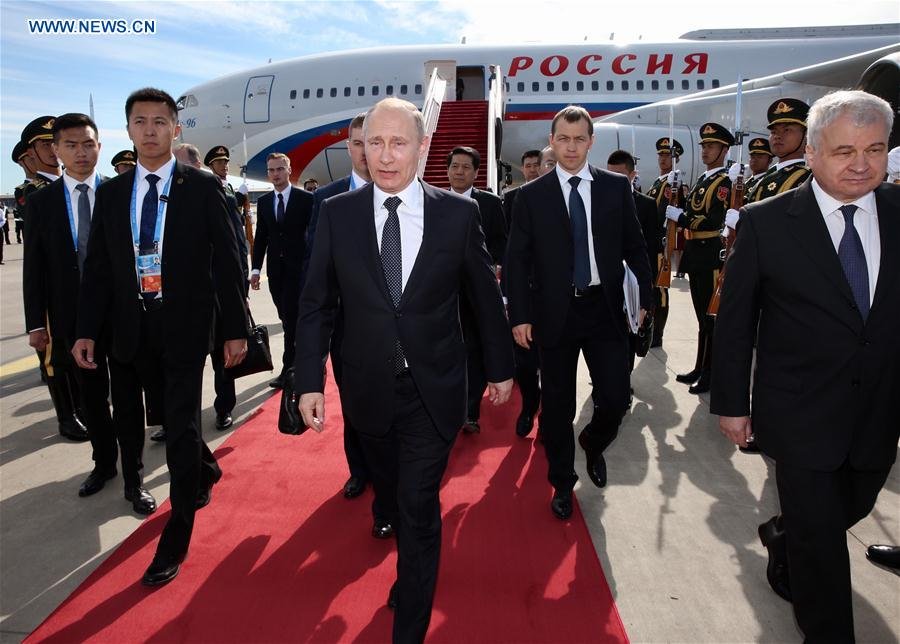
BEIJING — Russian President Vladimir Putin arrived in Beijing late Tuesday night, initiating a high-stakes, two-day diplomatic mission less than a week after U.S. President Donald Trump concluded his own landmark summit with Chinese leader Xi Jinping.
The arrival of the Russian leader marks a striking display of diplomatic maneuvering by Beijing. Within a single six-month window, China has hosted the leaders of the other four permanent members of the United Nations Security Council. However, the rapid back-to-back scheduling of Trump and Putin highlights China’s growing confidence as it centers itself within a deeply fractured global order.
A Rare Diplomatic Sequence: Reassurance vs. Stabilization
Putin’s plane touched down at Beijing Capital International Airport, where he was formally greeted by Chinese Foreign Minister Wang Yi alongside an official honor guard. While Kremlin aide Yuri Ushakov insisted there is “no connection” between the timing of the two visits, geopolitical analysts view the optics as a calculated message from Beijing to Washington.
During his private tour of the exclusive Zhongnanhai compound last week, President Xi pointedly reminded Donald Trump that Vladimir Putin was one of the few other world leaders to have ever been invited into the inner sanctum. The rapid transition from hosting Washington to welcoming Moscow allows China to project leverage, signaling to the United States that Beijing maintains powerful global partnerships that cannot be easily isolated.
“Hosting two of the most powerful leaders in the world in a matter of days shows China’s growing confidence in its place and standing in the world,” noted William Yang, a senior analyst at the International Crisis Group. “Xi likely wants to remind Trump that Beijing has other solid and robust relationships that it can count on.”
Deepening Economic Asymmetry Under Western Pressure
The Vladimir Putin Beijing state visit marks his 25th trip to China, a milestone that coincides with the 25th anniversary of the 2001 Sino-Russian Treaty of Friendship. On the eve of his arrival, Putin released a video address asserting that bilateral relations have reached an “unprecedented level,” praising the near-complete elimination of the U.S. dollar in favor of rubles and yuan for bilateral trade settlements.
Yet beneath the warm rhetoric, the economic relationship has grown increasingly lopsided. As Russia grapples with a stagnating frontline in Ukraine and mounting economic strain from Western sanctions, Moscow has become deeply dependent on Beijing as its primary economic lifeline.
Key Objectives on the Kremlin’s Agenda
- Energy Pipelines: Moscow is aggressively pushing for a finalized agreement on the Power of Siberia 2 pipeline. The 1,600-mile project through Mongolia would divert 50 billion cubic meters of natural gas toward Asia to compensate for lost European markets.
- Sanctions Bypassing: Securing continued Chinese supplies of high-tech components and dual-use machinery essential to sustaining Russia’s domestic industrial base.
- Maritime Security Diversification: Establishing overland supply resilience to insulate Chinese-bound energy shipments from volatile maritime routes, such as the Strait of Hormuz.
| Geopolitical Metric | The Trump Summit (May 12–15) | The Putin State Visit (May 19–20) |
| Primary Directive | Stabilizing trade ties and managing the Taiwan flashpoint | Reaffirming the “no-limits” strategic partnership |
| Bilateral Trade Tone | Competitive, transactional, threat of new tariff walls | Cooperative, lopsided integration, non-dollar settlements |
| Strategic Energy Impact | Discussions on protecting global shipping lanes | Progressing the Power of Siberia 2 overland pipeline |
The Future Outlook: Xi’s Triangular Diplomatic Blueprint
For President Xi Jinping, the simultaneous management of both relationships serves a distinct long-term strategy. By engaging in selective de-escalation with Trump over trade boundaries, China preserves its vital access to Western consumer markets. At the same time, by maintaining robust defense and economic coordinates with Putin, Beijing ensures a reliable, resource-rich buffer against Western encirclement.
While the Kremlin aims to use this visit to prove that international sanctions have failed to isolate Russia, Beijing’s focus remains firmly fixed on its own domestic stability. Moving forward, the true metric of success for Putin’s visit will not be the warmth of the state banquets, but whether Beijing is willing to risk secondary U.S. sanctions to grant Moscow the deep, structural energy and technological commitments it desperately requires.
Trendsetter Tribune