The wild, high-stakes partisan war over the American South’s congressional maps has taken another sharp, dramatic turn.
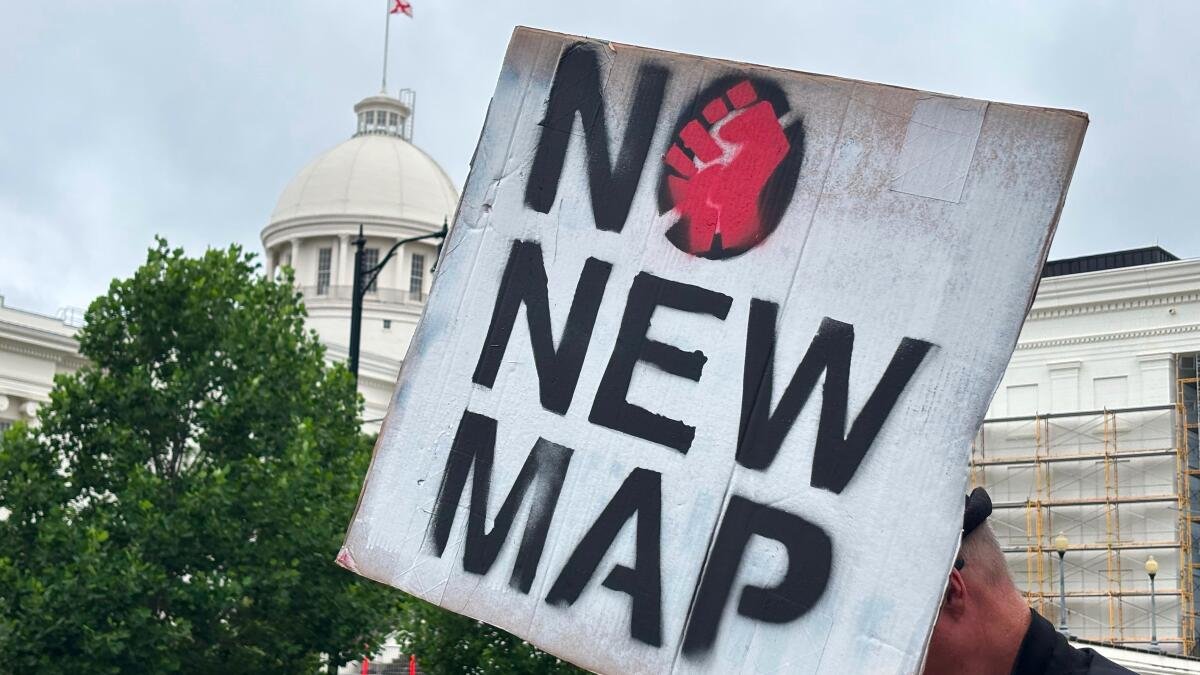
A panel of three federal judges issued a sweeping 102-page preliminary injunction that temporarily blocks the state of Alabama from using a controversial, Republican-backed congressional map for the upcoming midterm elections. The judges ruled that the state’s plan—which rolled back a court-mandated second majority-Black voting district—amounted to an intentional effort to dilute the political power of Black Alabamians.
The decision is a major blow to state Republicans, who had aggressively rushed to implement the friendlier lines in hopes of recapturing a competitive House seat currently held by freshman Democratic Representative Shomari Figures.
The Chaos of the Middle-of-the-Primary Reset
The ruling injects a massive dose of whiplash into an already deeply confusing 2026 election cycle.
Following a seismic U.S. Supreme Court ruling (Louisiana v. Callais) that weakened provisions of the federal Voting Rights Act, the high court temporarily cleared the way for Alabama to drop its court-approved 2024 lines. State Republicans acted instantly, pushing their preferred 2023 map back into play and prompting Republican Governor Kay Ivey to call a highly unusual set of special primaries for August 11 across four reconfigured districts.
But following a tense, seven-hour hearing, the three-judge panel—comprising Circuit Judge Stanley Marcus and District Judges Anna Manasco and Terry Moorer—scathingly rejected the state’s claim that its redrawn map was a neutral product of everyday party politics.
“Ultimately, we cannot see our way clear to requiring Alabamians to cast their votes in the 2026 elections under a districting plan tainted by intentional race-based discrimination. We again cannot understand the 2023 Plan as anything other than an intentional effort to dilute Black Alabamians’ voting strength.”
The judges emphasized that forcing a last-minute swap to the state’s map would trigger a “logistically impossible voter reassignment effort.” Instead, the court ordered election officials to immediately revert to the previous race-blind remedial map drawn by a court-appointed special master—a system already loaded into county databases.
A Ticking Clock for Control of the House
The legal tug-of-war is an explicit proxy battle for a crucial seat in a closely divided U.S. House of Representatives.
The two maps represent drastically different outcomes for the state’s political makeup:
| Enacted 2024 Court Map | Reenacted 2023 Republican Map |
| Two Majority-Black Districts | One Majority-Black District |
| Features two districts where Black residents compose a clear majority or close to it (Districts 2 and 7). | Packs Black voters heavily into a single district while distributing the rest to dilute their collective voting power. |
| Current Standings: 5 Republicans, 2 Democrats. Anchors Rep. Shomari Figures (D) in a newly competitive District 2. | GOP Target: Reshapes District 2 into a solidly conservative bastion, giving Republicans a distinct structural advantage to flip the seat. |
The Supreme Court Showdown Looms
Civil rights advocates and plaintiffs quickly celebrated the decision as a critical defense of the 14th Amendment. Deuel Ross, director of litigation for the NAACP Legal Defense Fund, stated that the court had “again vindicated the constitutional rights of voters in the Black Belt.”
However, the legal fight is nowhere near over. Alabama Attorney General Steve Marshall, a Republican, lashed out at the panel’s ruling, describing the state’s legislative plan as a “blandly unobjectionable congressional map” and promising an immediate, emergency appeal to the conservative majority of the U.S. Supreme Court.
“Know this—in my mind, it is not a matter of whether we win this case, only when,” Marshall warned.
With the August special primary dates rapidly approaching, the case is poised to serve as the ultimate litmus test for just how far state legislatures can push redistricting boundaries under the high court’s newly altered voting rights guidelines. For now, the court-ordered maps stand, and the state’s chaotic midterm pipeline remains frozen in place.
Trendsetter Tribune