 By Trendsetter Tribune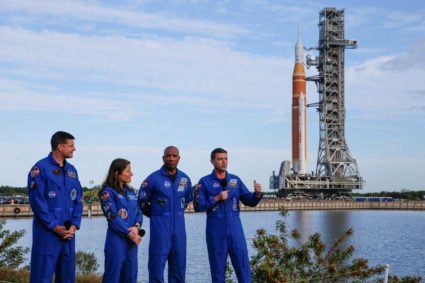
After decades of anticipation and several weeks of technical delays, NASA is officially on the launchpad for its first crewed lunar mission since 1972. As of Monday, March 30, 2026, the Artemis II mission is finalized for liftoff this Wednesday, April 1, under a “Pink Moon” sky that mission planners are calling a poetic backdrop for humanity’s return to deep space.
The Launch Details
The mission will utilize the Space Launch System (SLS), currently the most powerful operational rocket in the world, to propel the Orion spacecraft on a 10-day journey.
- Launch Date: Wednesday, April 1, 2026.
- Window Opens: 6:24 p.m. EDT.
- Location: Launch Complex 39B, Kennedy Space Center, Florida.
- Weather Forecast: Meteorologists are predicting an 80% chance of favorable conditions, with only minor concerns regarding cloud coverage and coastal winds.
- The Delay: The mission was pushed back from its original February target due to minor hydrogen fuel leaks and pressurization issues in the upper stage, both of which NASA confirmed were fully resolved following a successful “Wet Dress Rehearsal.”
The Historic Crew
The four-person crew represents several “firsts” in lunar exploration history:
| Role | Astronaut | Significance |
| Commander | Reid Wiseman (NASA) | Veteran Navy pilot and former Chief of the Astronaut Office. |
| Pilot | Victor Glover (NASA) | The first Person of Color to travel to the Moon. |
| Mission Specialist | Christina Koch (NASA) | The first woman to travel to the Moon; holds the record for the longest single female spaceflight. |
| Mission Specialist | Jeremy Hansen (CSA) | The first non-U.S. citizen (Canadian) to leave Earth’s orbit. |
The Mission Profile: A “Free-Return” Trajectory
Unlike the upcoming Artemis III landing mission, Artemis II is a high-stakes flight test designed to verify that the Orion capsule’s life support systems can keep humans alive in deep space.
- High Earth Orbit: After launch, the crew will spend the first 24 hours in a high elliptical orbit to test the ship’s proximity operations and rendezvous capabilities.
- The “Slingshot”: Orion will then perform a Trans-Lunar Injection (TLI) burn, sending the crew 4,600 miles (7,400 km) beyond the far side of the Moon.
- Record Distance: The crew is expected to reach a maximum distance of roughly 230,000 miles from Earth, surpassing the record for human distance set by the Apollo 13 crew.
- No Orbit, No Landing: Using a “free-return” trajectory, the Moon’s gravity will naturally pull the spacecraft back toward Earth without requiring a second major engine burn, ensuring a safe return even if propulsion fails.
The Road to the Surface (Artemis III & IV)
While Artemis II will only circle the Moon, it is the essential “green light” for the first lunar landing in over 50 years.
- Artemis III (Mid-2027): This mission was recently adjusted to focus on docking and EVA (spacewalk) tests in Low Earth Orbit with SpaceX’s Starship HLS and Blue Origin’s Blue Moon landers.
- The Next Landing (2028): Current NASA projections target 2028 for the actual return to the lunar surface (Artemis IV), provided the landing technologies and new Axiom space suits are fully vetted during the 2027 test flight.