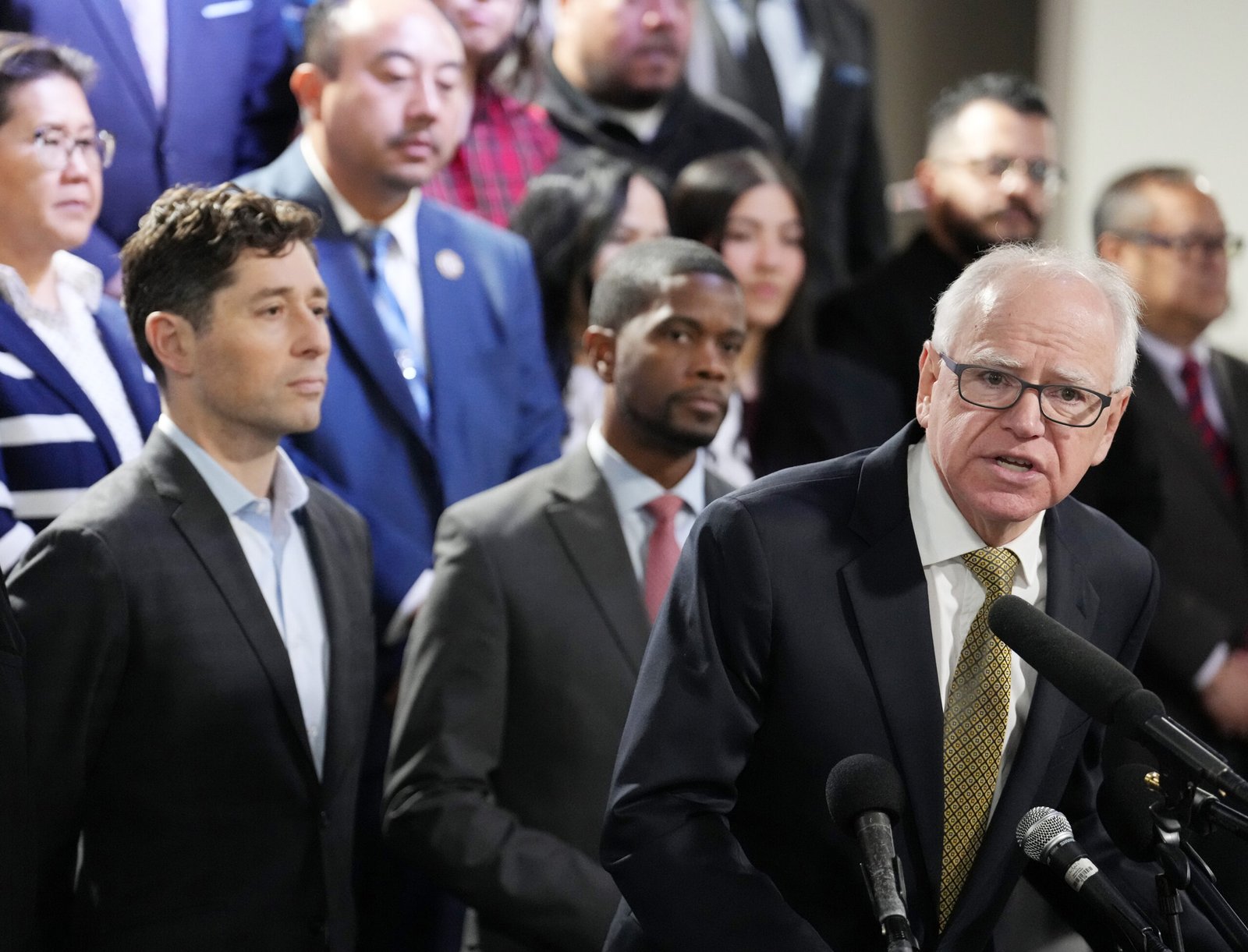
Gov. Tim Walz speaks during a press conference with Minneapolis Mayor Jacob Frey, St. Paul Mayor Melvin Carter, Saint Paul Mayor-elect Kaohly Her, Bishop Richard D. Howell, Jr, and fellow community leaders to address recent federal immigration enforcement efforts in Minnesota amid an increased ICE presence and targeting of U.S. citizens in the state Tuesday, Dec. 23, 2025 at Shiloh Temple in north Minneapolis. ] ANTHONY SOUFFLE • anthony.souffle@startribune.com
In a blistering rebuke of the White House’s immigration enforcement tactics, a federal judge has blocked the Trump administration’s attempt to enforce grand jury subpoenas against Minnesota Governor Tim Walz and several top state and local officials.
In a ruling unsealed on Monday, June 22, 2026, U.S. District Judge Patrick Schiltz fiercely criticized the Department of Justice (DOJ). He concluded that federal prosecutors were unlawfully manipulating the grand jury process not to unearth criminal activity, but to bully and retaliate against Democratic officials who refuse to assist with sweeping federal immigration crackdowns.

The Coercive “Dominant Purpose”
The legal battle ignited in January 2026, when the DOJ served records-seeking subpoenas to a wide net of high-profile Minnesota leaders. The administration claimed it was investigating whether state and local authorities had illegally obstructed or impeded federal law enforcement during a highly contentious Immigration and Customs Enforcement (ICE) operation in the Minneapolis–St. Paul area.
Judge Schiltz completely dismissed that premise, writing that the connection between any alleged criminal violation and the information the DOJ demanded was “extremely weak to nonexistent.”
“The dominant purpose [of the subpoenas was] to coerce Minnesota officials into assisting the federal government with enforcing civil immigration law and to harass and retaliate against them for failing to do so. The Justice Department is not conducting a criminal investigation, but is instead using the grand jury process for other (unlawful) purposes.”
— U.S. District Judge Patrick Schiltz
The judge stressed that the information targeted by the federal government consisted almost entirely of constitutionally protected conduct. Furthermore, he reminded federal prosecutors that under well-established constitutional principles, the state of Minnesota possesses the absolute legal right to choose not to dedicate its local resources to enforcing federal civil immigration rules.


The Retaliation Target List
The quashed grand jury subpoenas represented a wide-ranging dragnet aimed directly at the executive leadership of the state and its twin largest cities:
The Trump Administration's Minnesota Subpoena Dragnet
├── Governor's Office:           Gov. Tim Walz (2024 Democratic VP Nominee)
├── Attorney General's Office:   Keith Ellison
├── Municipal Executives:        Minneapolis Mayor Jacob Frey & St. Paul Mayor Kaohly Her
└── County Jurisdictions:        Ramsey County & Hennepin County Officials
The administration’s aggressive investigation followed a period of escalating federal-state friction. In early 2026, tensions boiled over into mass demonstrations in the Twin Cities after federal agents were involved in the fatal operations of two individuals, Renee Good and Alex Pretti.
During the height of the unrest, President Donald Trump openly threatened to deploy the military via the Insurrection Act to quell the protests, while publicly accusing Governor Walz and local mayors of actively encouraging agitators to disrupt ICE operations.
The Targets React: “Retaliation, Pure and Simple”
The unsealing of the judicial order triggered a wave of triumphant responses from Minnesota leaders, who framed the ruling as a critical firewall against the politicization of federal law enforcement.
| Official | Reaction & Statement |
| Gov. Tim Walz | Called the ruling “a victory for the rule of law and our democracy.” He added: “The U.S. Justice Department is pursuing criminal investigations into the President’s political opponents… we are seeing daily reminders of this administration’s lawlessness.” |
| AG Keith Ellison | Stated that the decision should alarm every citizen regardless of party alignment, asserting that the White House is openly weaponizing the justice system against political adversaries. |
| Mayor Jacob Frey | Argued the DOJ’s probe was “never about justice, law, and order, but the absence of it.” He emphasized that criticizing federal overreach or speaking on behalf of constituents is a core American right, not a federal crime. |
The Justice Department stood by its actions in a brief follow-up statement, maintaining that it takes the obstruction of federal officers “extremely seriously” and arguing that its investigators acted in full compliance with the law.
Nevertheless, the ruling stands as a major judicial bottleneck for the administration’s broader campaign to legally penalize “sanctuary” jurisdictions, demonstrating that federal courts will not allow the grand jury system to be transformed into a tool for political coercion.
Trendsetter Tribune