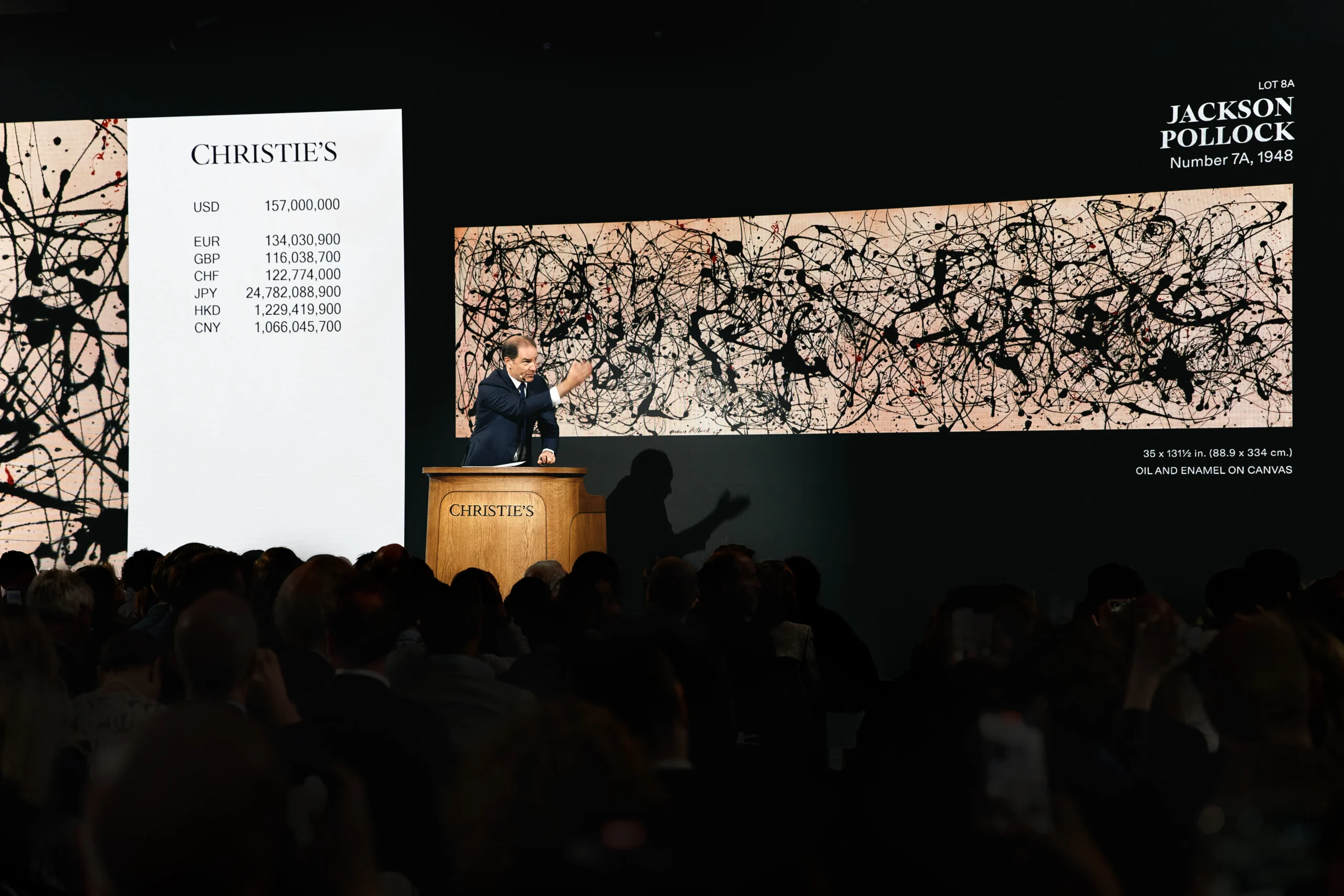
NEW YORK — In a historic evening that shook the global art market, a monumental drip painting by Jackson Pollock sold for an astonishing $181.2 million at Christie’s in New York.
The blockbuster sale of Number 7A, 1948 comfortably set a new Jackson Pollock Christie’s auction record, obliterating the artist’s previous auction high by $120 million—a staggering 175% leap in valuation. The masterpiece anchored “Masterpieces: The Private Collection of S.I. Newhouse,” a elite white-glove auction consisting of 16 works from the estate of the late media titan and Condé Nast chairman. The sale propelled Christie’s to a massive $1.12 billion single-evening total.
Seven Minutes of Suspense: Inside the Bidding War
The atmosphere inside Christie’s Rockefeller Center salesroom was described by attendees as highly theatrical, as auctioneer Adrien Meyer launched the bidding for the Pollock masterpiece at $82 million.
The lot quickly escalated into a fierce, seven-minute three-way contest. Phone bidders traded rapid, steady $1 million increments, pushing the price past the $100 million threshold within minutes. At $153 million, a late-stage phone contender attempted to swoop in and steal the lot, but a persistent collector bidding via Christie’s global president, Alex Rotter, held firm. The hammer ultimately fell at a historic $157 million, reaching the final $181.2 million tally once premiums and commissions were added.
“It is with this work that Pollock finally frees himself from the shackles of conventional easel painting and produces one of the first truly abstract paintings in the history of art,” Christie’s noted in a post-sale statement.
The Anatomy of a Masterpiece
Spanning over three meters (nearly 11 feet) in width, Number 7A, 1948 features Pollock’s signature intricate web of black and white enamel drips, punctuated by brilliant flecks of red.
Of Pollock’s 29 large-scale, monumental drip compositions from this defining era, Number 7A was the largest remaining in private hands. S.I. Newhouse originally acquired the museum-grade work in 2000 from Alfred Taubman, the former owner of Sotheby’s, for an undisclosed sum. Market analysts highlighted that a Pollock canvas of this significance and scale had not appeared on the open market in more than six decades.
The Top Tier Reshuffled
The final price tag places the painting into an elite bracket of art history:
- The Ranking: It is now officially the fourth most expensive painting ever sold at public auction.
- The Abstract Crown: It stands as the single most expensive “truly abstract” painting in auction history.
- Private vs. Public: While private, off-market handshakes have reportedly valued other Pollock works near $200 million, this result sets an indisputable, transparent public benchmark for the Abstract Expressionist movement.
| Auction Data Metric | Previous Record (2021) | New Record Result | Market Surge |
| Masterpiece Title | Number 17, 1951 | Number 7A, 1948 | Change of featured era |
| Final Price (With Fees) | $61.2 Million | $181.2 Million | +$120 Million |
| Auction Venue | Sotheby’s New York | Christie’s New York | Marquee Spring Week |
A Billion-Dollar Night Confirms Market Health
The record-shattering Pollock lot sparked a broader wave of competitive bidding that lifted several other legendary twentieth-century masters to new heights during the back-to-back sessions.
The evening saw Romanian modernist Constantin Brâncuși’s bronze head sculpture, Danaïde (ca. 1913), soar to a record $107.6 million, making him only the second sculptor in history to cross the $100 million threshold. Moments later, Mark Rothko’s vibrant canvas No. 15 (Two Greens and Red Stripe) brought in $98.4 million, bypassing his previous auction high of $86.9 million set back in 2012.
The consecutive successes signaled to financial watchdogs that despite lingering macro-economic uncertainties, serious global capital remains deeply and aggressively committed to acquiring top-tier, blue-chip cultural trophies.
Trendsetter Tribune