 By Trendsetter Tribune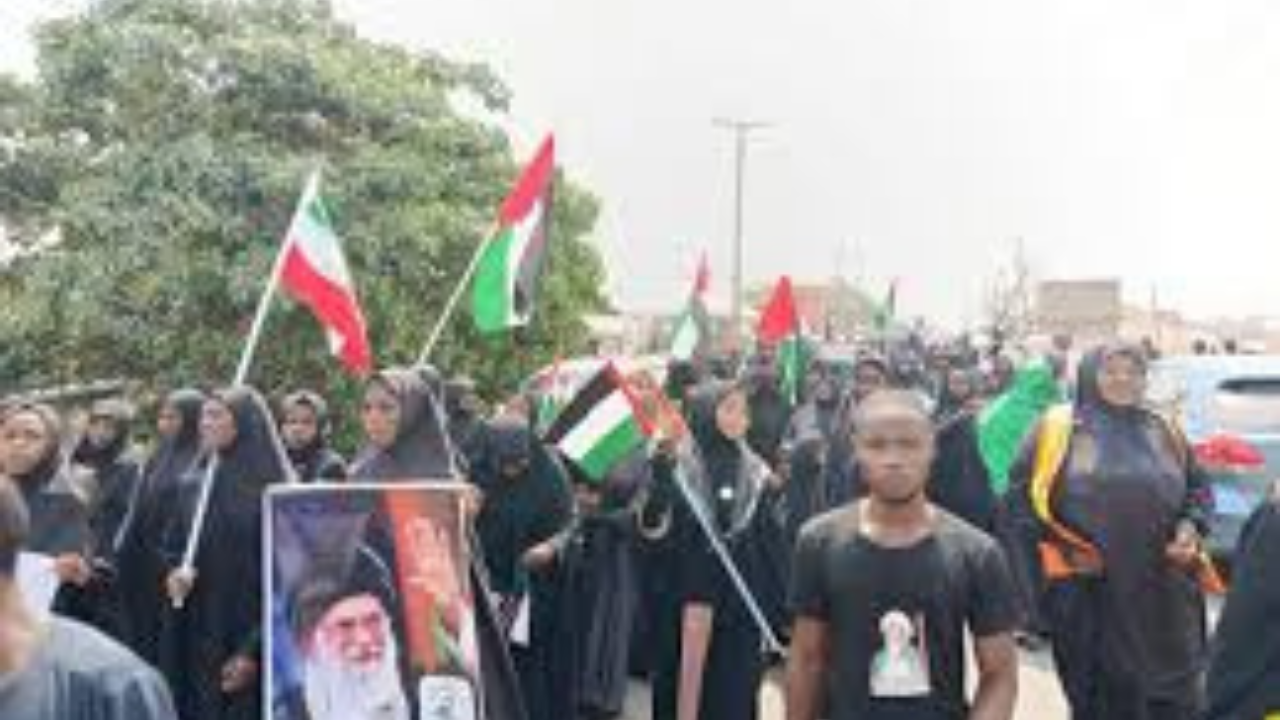
As the war between the U.S.-Israeli coalition and Iran intensifies, the geopolitical shockwaves have reached Nigeria, sparking a series of contrasting reactions that follow the country’s deep religious and regional fault lines.
Over the past week, viral social media footage has captured the starkly different sentiments of Northern Muslims and Eastern Christians, turning the Middle East crisis into a mirror for Nigeria’s own internal dynamics.
The North: Protests and “Solidarity with the Oppressed”
In several northern cities, including Kano, Kaduna, and Zaria, thousands of members of the Islamic Movement in Nigeria (IMN) and other Muslim groups have taken to the streets.
- The Protests: Protesters were filmed carrying portraits of the late Ayatollah Ali Khamenei and burning U.S. and Israeli flags. The demonstrations were largely characterized by chants of “Death to America” and “Death to Israel,” with leaders framing the strikes on Iran as an attack on the global Muslim community (Ummah).
- Motivations: For many in the North, particularly those of the Shia faith, Iran represents a bastion of resistance against Western “imperialism.” The death of Khamenei on February 28 has been mourned as the “martyrdom of a global leader.”
- Clerics’ Warnings: While the IMN was vocal, some Sunni clerics in the region have urged caution. A group of Islamic scholars in Abuja issued a statement on March 1, warning Nigerians “not to join protests you know nothing about,” fearing that the demonstrations could lead to local instability or clashes with security forces.
The East and South: Celebrations and “The Shield of Israel”
In sharp contrast, videos from Enugu, Onitsha, and parts of Lagos show groups of Christians—many from the Igbo heartland—openly celebrating the news of the successful U.S. and Israeli strikes.
- The Celebrations: Footage showed individuals waving the Israeli flag and cheering as news of the “Epic Fury” strikes broke. Some videos featured street gatherings where participants offered prayers for the “protection of the Holy Land,” viewing Israel’s military prowess as a divine victory.
- Theological Connection: Many Christians in Eastern Nigeria identify strongly with Israel, often referring to themselves as the “Igbos of Israel.” For this demographic, Israel is viewed as a biblical homeland and a symbol of resilience against “persecution,” drawing parallels to their own history.
- Pilgrimage Disruptions: The enthusiasm has been tempered by the reality of the war; on March 5, the Nigerian Christian Pilgrim Commission (NCPC) officially suspended all pilgrimages to Israel and the West Bank, leaving thousands of disappointed travelers stranded as the Easter season approaches.
Government Response: A Stance of Non-Alignment
The Federal Government of Nigeria has moved quickly to manage the rising internal tensions, fearing that the “war of words” on social media could translate into sectarian violence at home.
| Entity | Position |
| Ministry of Foreign Affairs | Called for “maximum restraint” and a return to dialogue, citing “grave consequences” for global stability. |
| U.S. Embassy in Abuja | Issued a high-level security alert on March 5, warning American citizens of “potential demonstrations” and clashes in the capital. |
| NiDCOM | Assured the public that the government is monitoring the safety of Nigerians in the Gulf and preparing for potential evacuations from Qatar and the UAE. |
The Social Media Echo Chamber
The viral videos have become a flashpoint for debate on Nigerian X (formerly Twitter) and TikTok. While some users call for national unity, others have used the conflict to sharpen regional rhetoric. The Sultan of Sokoto, Sa’ad Abubakar III, has notably remained silent on the specific strikes, instead focusing on routine religious directives, a move some analysts interpret as an attempt to avoid further inflaming the situation.
JUST IN: Shiites protest in Northern Nigeria over killing of Iran’s Supreme Leader, Khamenei by Israeli IDF and US Military yesterday. pic.twitter.com/UgO9NeookJ
— Kiu tv (@KizyUzoma) March 1, 2026
Biafrans has spoken pic.twitter.com/KPosWDtkpX
— Nwaeze Simon Ekpa (@WilsonEze03) March 9, 2026