 By Trendsetter Tribune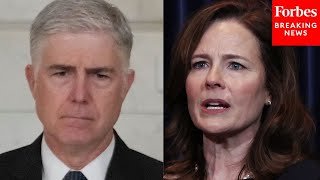
During today’s high-stakes oral arguments in Trump v. Barbara (April 1, 2026), Justices Neil Gorsuch and Amy Coney Barrett emerged as some of the most rigorous skeptics of the administration’s effort to end birthright citizenship.
While the President watched from the front row—the first time a sitting president has attended a Supreme Court argument in person—Solicitor General D. John Sauer faced a barrage of questions that targeted the textual and historical foundations of Executive Order 14160.
Justice Barrett: The Textualist Critique
Justice Barrett focused heavily on the specific language of the 14th Amendment and the Immigration and Nationality Act (INA), questioning why the administration was “reading in” words that do not exist.
- The Missing Words: Barrett pressed Sauer on why the Citizenship Clause focuses entirely on the person who is “born” rather than their parents. She noted that other sections of the INA explicitly use the words “mother,” “father,” or “parental domicile” when Congress intends to create parent-based rules.
- The “Studious Omission”: “Why isn’t the studious omission of such words in the birthright-citizenship amendment near-fatal to your position?” she asked, suggesting that for a textualist, the absence of parental requirements in the 14th Amendment is a powerful signal of intent.
- Injunction Authority: Barrett also revisited her previous concerns regarding “universal injunctions,” questioning whether lower courts have the power to block the order nationwide, even as she signaled skepticism of the order’s merits.
Justice Gorsuch: The “New World” vs. The Old Constitution
Justice Gorsuch focused on the administration’s “originalist” defense, which argues that “subject to the jurisdiction” implies a deep political allegiance that undocumented immigrants cannot provide.
- “Same Constitution”: When Sauer argued that the 1898 Wong Kim Ark precedent was outdated because “8 billion people are one plane ride away” from having a child on U.S. soil, Gorsuch reportedly quipped: “It’s a new world, but it’s the same Constitution.”
- The 150-Year Precedent: Gorsuch questioned the “onus” on the government to provide “compelling evidence” to revise 150 years of executive and judicial practice. He seemed wary of the administration’s “contrived parental rules,” comparing them to “made-up” legal frameworks from past eras that the current Court has criticized.
- The “Under the Flag” Test: Gorsuch pressed for a simpler interpretation: if a person can be prosecuted in an American court for violating American law, are they not “subject to the jurisdiction” of the United States? He suggested that the “under the flag” test—being born within the physical territory—is the historically consistent reading.
Key Confrontations with the Solicitor General
The Justices also joined Chief Justice John Roberts in questioning the “idiosyncratic” nature of the government’s examples.
| Justice | The “Quirky” Argument Questioned |
| Chief Justice Roberts | Questioned how the government can jump from tiny exceptions (children of ambassadors/invading armies) to a “whole class of millions of people.” |
| Justice Gorsuch | Challenged the definition of “domicile,” asking why children of “wandering” groups were historically granted citizenship if parental residence was the deciding factor. |
| Justice Barrett | Asked if the President would be “free to change his rules at whim” in the future—such as requiring both parents to be citizens—if the Court accepts this executive-led reinterpretation. |
The President’s Early Exit
Reports indicate that the President left the courtroom shortly after the Solicitor General finished his argument, reportedly appearing displeased with the skeptical line of questioning from his own appointees. As Cecillia Wang of the ACLU took the lectern to argue for the plaintiffs, the mood in the chamber suggested that the administration faces a steep uphill battle to convince the 6-3 conservative majority to upend more than a century of settled law.