 By Trendsetter Tribune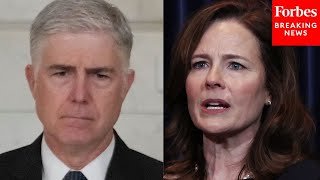
During the high-stakes oral arguments in Trump v. Barbara on Wednesday, April 1, 2026, several of the Supreme Court’s conservative justices—including those appointed by the current President—expressed deep skepticism toward the administration’s attempt to end birthright citizenship via executive order.
Despite the President’s unprecedented decision to attend the arguments in person, the questioning from Justices Neil Gorsuch and Amy Coney Barrett suggested that the administration’s “originalist” defense of Executive Order 14160 may be on thin legal ice.
Key Points of Judicial Skepticism
The administration’s central argument is that children of undocumented immigrants are not “subject to the jurisdiction” of the U.S. within the meaning of the 14th Amendment. However, the bench appeared unpersuaded by this reinterpretation of the 1898 Wong Kim Ark precedent.
- The Textualist Wall: Justice Amy Coney Barrett pointedly questioned why the 14th Amendment focuses on the status of the child who is “born” rather than the parents. She noted that when Congress wants to make citizenship contingent on parental status, it uses explicit language like “mother,” “father,” or “domicile”—words that are “studiously omitted” from the Constitutional text.
- “The Same Constitution”: Justice Neil Gorsuch pushed back against Solicitor General D. John Sauer’s claim that modern migration levels justify a departure from 150 years of practice. “It’s a new world, but it’s the same Constitution,” Gorsuch remarked, suggesting that policy concerns do not grant the Executive the power to rewrite settled constitutional law.
- The “Under the Flag” Test: Gorsuch further challenged the administration’s definition of “jurisdiction,” implying that if a person is subject to U.S. laws and can be prosecuted in U.S. courts, they are, by definition, within the country’s jurisdiction.
The “Wong Kim Ark” Precedent
The Solicitor General argued that the landmark 1898 ruling only applied to “lawful permanent residents.” The justices, however, seemed wary of this narrow reading.
| Justice | Line of Inquiry |
| Chief Justice Roberts | Questioned how the government could expand tiny exceptions (like children of foreign diplomats) to exclude a class of millions. |
| Justice Gorsuch | Challenged the “contrived” nature of the new parental rules, comparing them to past legal frameworks the Court has previously rejected. |
| Justice Kavanaugh | Focused on the reliance interests of millions of families who have built lives under the assumption that the 14th Amendment was “settled.” |
The President’s Early Exit
In a moment that stunned courtroom observers, the President reportedly departed the chamber shortly after the Solicitor General finished his remarks. His exit occurred just as Cecillia Wang of the ACLU began her argument for the plaintiffs, representing “Baby Barbara” and the thousands of other infants whose citizenship has been denied recognition since February 2025.
Legal Outlook: A “Permanent Subclass”?
The liberal wing of the court, led by Justice Ketanji Brown Jackson, warned that upholding the order would effectively create a “permanent subclass” of stateless individuals born on American soil. With several key conservatives appearing to align with the textualist and precedential arguments against the order, legal analysts now suggest the administration faces a significant uphill battle.