 By Trendsetter Tribune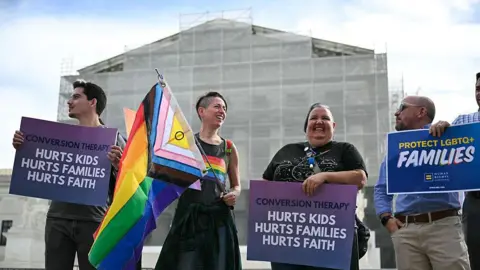
In a landmark 8-1 decision released today, Tuesday, March 31, 2026, the Supreme Court ruled in Chiles v. Salazar that Colorado’s law prohibiting licensed therapists from practicing conversion therapy on minors likely violates the First Amendment. The ruling represents a significant shift in how the Court views the intersection of professional medical regulation and freedom of speech.
The case was brought by Kaley Chiles, a Christian licensed counselor who argued that the state’s ban unconstitutionally censored her “faith-based talk therapy” and prevented her from helping clients seeking to align their identity with their biological sex.
1. Viewpoint Discrimination Over Conduct Regulation
The core of the majority opinion, authored by Justice Neil Gorsuch, rejected Colorado’s argument that the law merely regulates “professional conduct.”
- “Speech as Speech”: Gorsuch wrote that Colorado was not regulating speech incidental to a medical procedure (like surgery), but was instead regulating “speech as speech.”
- The Shield of Orthodoxy: The Court found the law imposed a “state-approved message” while penalizing dissenting views. Gorsuch noted that the First Amendment “stands as a shield against any effort to enforce orthodoxy in thought or speech.”
- Strict Scrutiny Applied: The Court vacated the lower court’s “rational basis” review and ordered that the law must meet strict scrutiny—the highest legal hurdle, which requires the state to prove the law is “narrowly tailored” to a compelling interest. The majority strongly hinted the ban would fail this test.
2. A Surprising 8-1 Coalition
While the Court is often divided on LGBTQ+ issues, this ruling saw an unusual alliance:
- Liberal Concurrence: Justices Elena Kagan and Sonia Sotomayor joined the majority. In a concurring opinion, Kagan wrote that a state could similarly not ban talk therapy designed to affirm a minor’s identity. She argued that once the state “suppresses one side of a debate,” the constitutional violation becomes straightforward.
- The Lone Dissenter: Justice Ketanji Brown Jackson was the sole vote in favor of upholding the ban.
3. Justice Jackson’s “Blistering” Dissent
Justice Jackson delivered her dissent from the bench, a rare move reserved for cases of deep disagreement.
- The “Can of Worms”: Jackson argued the ruling “opens a dangerous can of worms” by stripping states of their power to regulate healthcare providers.
- Medical Standards: She contended that because Chiles is a licensed professional, her “treatment-related speech” is a form of medical care that the state has a duty to regulate for safety.
- The Circular Logic: Jackson called the majority’s reasoning “maddeningly circular,” arguing that a medical treatment shouldn’t be immune to regulation just because it is administered through talking rather than a scalpel.
4. Impact on Other States
This decision casts immediate doubt on the “conversion therapy” bans currently active in roughly two dozen states and the District of Columbia.
- Malpractice vs. Speech: While the ruling protects a therapist’s right to talk, advocates like the Born Perfect campaign noted that conversion therapy remains contrary to the ethical standards of every major medical association (AMA, APA, AAP).
- Future Litigation: Legal experts expect a wave of lawsuits from counselors in states like California, Washington, and New York to overturn existing bans based on this new Supreme Court precedent.
5. Part of a Broader Pattern
The ruling is being viewed as the latest in a string of Supreme Court victories for religious liberty and First Amendment claims over state-level LGBTQ+ protections. It comes just 24 hours before the Court is set to hear arguments in Trump v. Barbara, the high-stakes battle over birthright citizenship.